The other route
Before you read anything
$7 + 8$, and then $7 + 7$. Do the second one first.
Now look at the two sums side by side and say what the difference between them is. Not the answers — the difference.
Two people, two routes
Musa fills up to ten: seven needs three, so $10 + 5$.
Amina sees $7 + 7$ with one more: fourteen, then fifteen.
seven needs three, so ten and five
double seven is fourteen, and one more
Both are right. Both are fast. Neither counted.
So which one?
Look at the two numbers before you start. That is the whole decision, and it takes no time at all.
Close together — $7 + 8$, $6 + 7$, $9 + 8$ — and the double is nearer, so use it. Far apart — $9 + 4$, $8 + 3$ — and there is no double to lean on, so fill up to ten.
:x nutshell-near-double
A sum whose two numbers are one or two apart, so a double you already know gets you there in one step.
A :near double is not a third method. It is the same move — start from a fact you have, and adjust — pointed at a different fact.
The one that looks like both
$6 + 7$ is a near double and it crosses ten. Either route arrives, so take the one you see first. There is no wrong choice here — the point of having two is that you are never stuck.
Check yourself
Eight, mixed
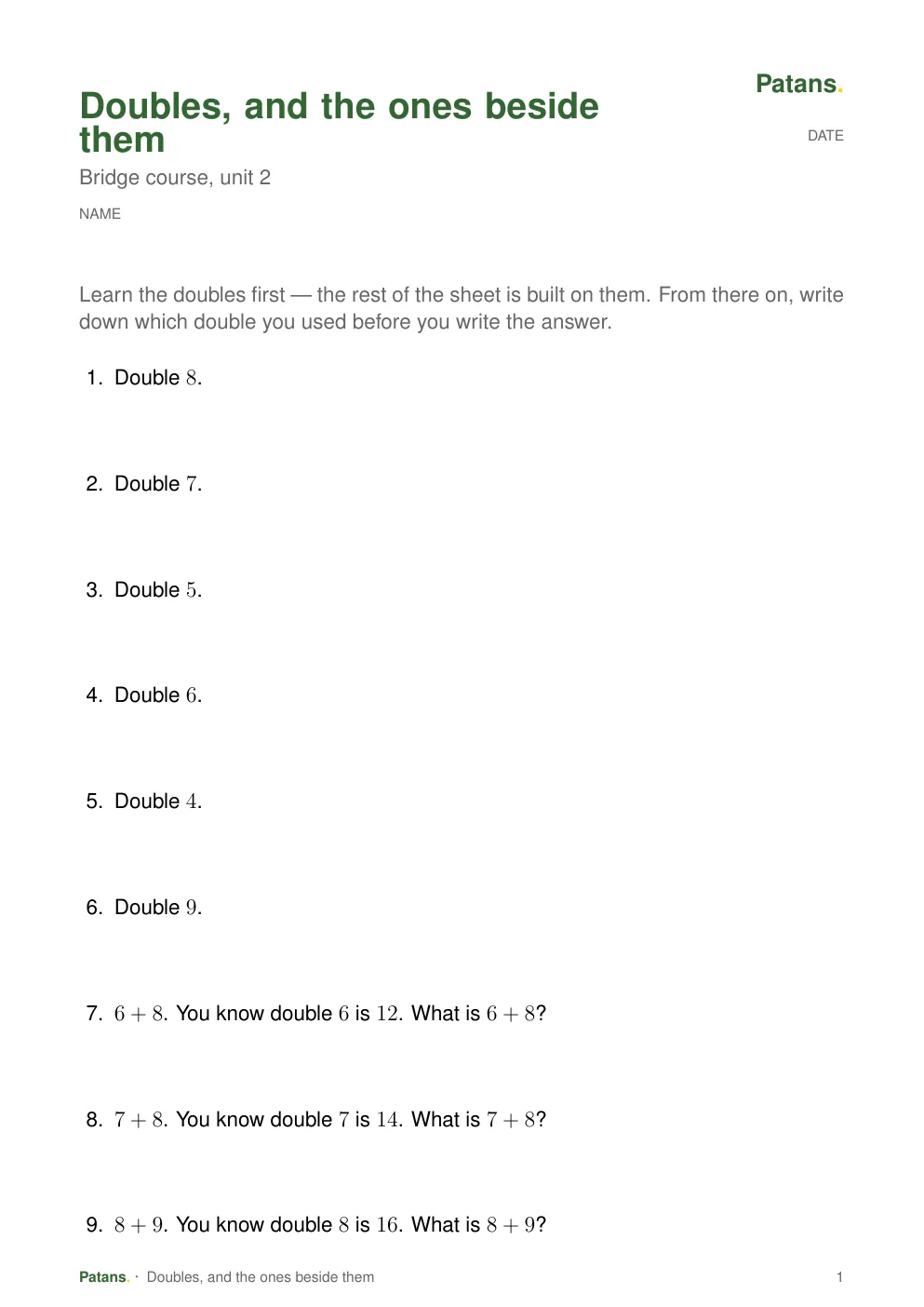
Double $8$.
Double $7$.
Double $5$.
Double $6$.
Double $4$.
Double $9$.
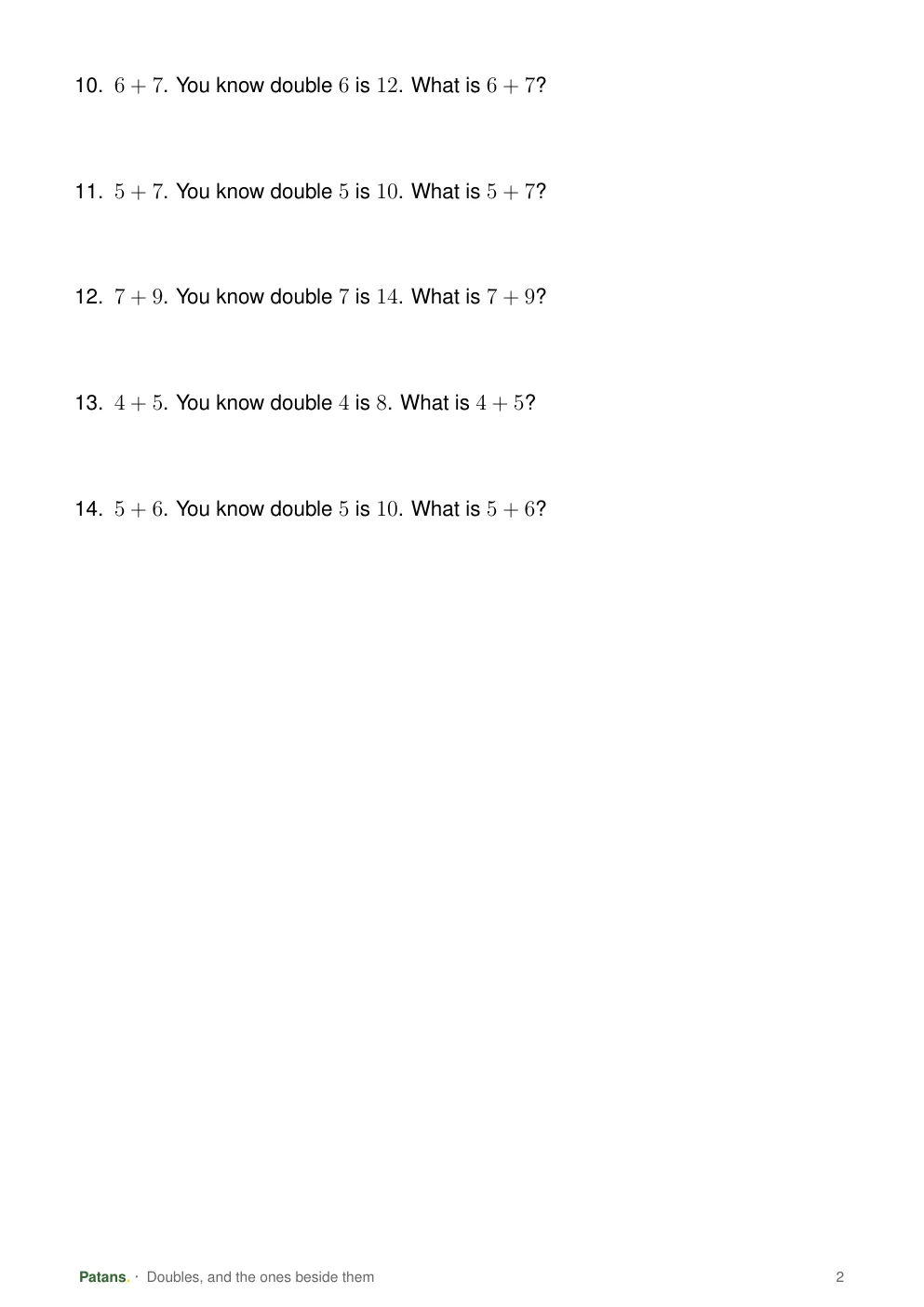
$6 + 8$. You know double $6$ is $12$. What is $6 + 8$?
$7 + 8$. You know double $7$ is $14$. What is $7 + 8$?
Show that you have it
The fact, and the one beside it
You know $7 + 9 = 16$. What is $67 + 9$?
You know $9 + 8 = 17$. What is $29 + 8$?