When a column runs out
Before you read anything
Put out thirteen loose sticks. Now make a bundle of ten and see what is left.
You have not changed how many you have. Say what you have changed.
Thirteen is still thirteen
Ten ones became one ten. Same quantity, fewer things, and now the tens column has something in it that it did not have a moment ago.
:x nutshell-exchange
Swapping ten of one size for one of the next size up. Nothing is gained or lost — it is the same amount, held differently.
This is what carrying is
$47 + 8$. Seven ones and eight ones is fifteen ones, which is more than a column can hold. So ten of them become a ten, and three are left over: five tens and five ones.
That is :exchange, and it is the only thing the little carried 1 has ever meant.
knew the 1 was a bundle, not a rule
Going the other way
$52 - 7$. There are only two ones, so a ten gets opened: four tens and twelve ones, and twelve take seven is five. Borrowing is exchange, backwards — and module 2 was doing it without the word.
What you have been saying without noticing
Forty is four tens. Eighty is eight tens. You have said those all module, and each one is a count of equal groups — which is a multiplication, out loud, before anybody called it one.
So: what else in arithmetic is really a count of equal groups?
Check yourself
Six to try
You have $17$ ones. You bundle ten of them into a ten. How many ones are left over?
You have $13$ ones. You bundle ten of them into a ten. How many ones are left over?
You have $11$ ones. You bundle ten of them into a ten. How many ones are left over?
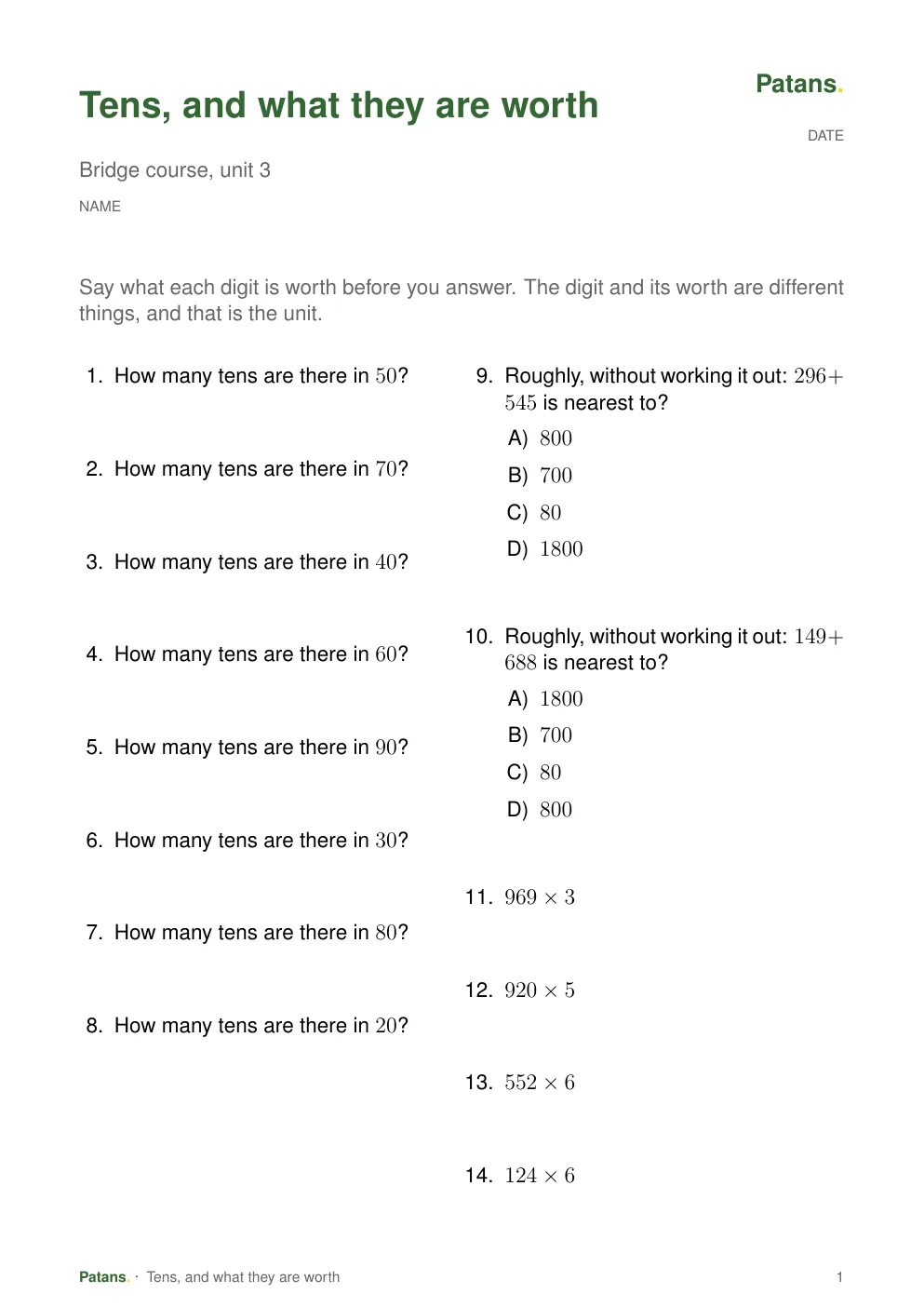
How many tens are there in $50$?
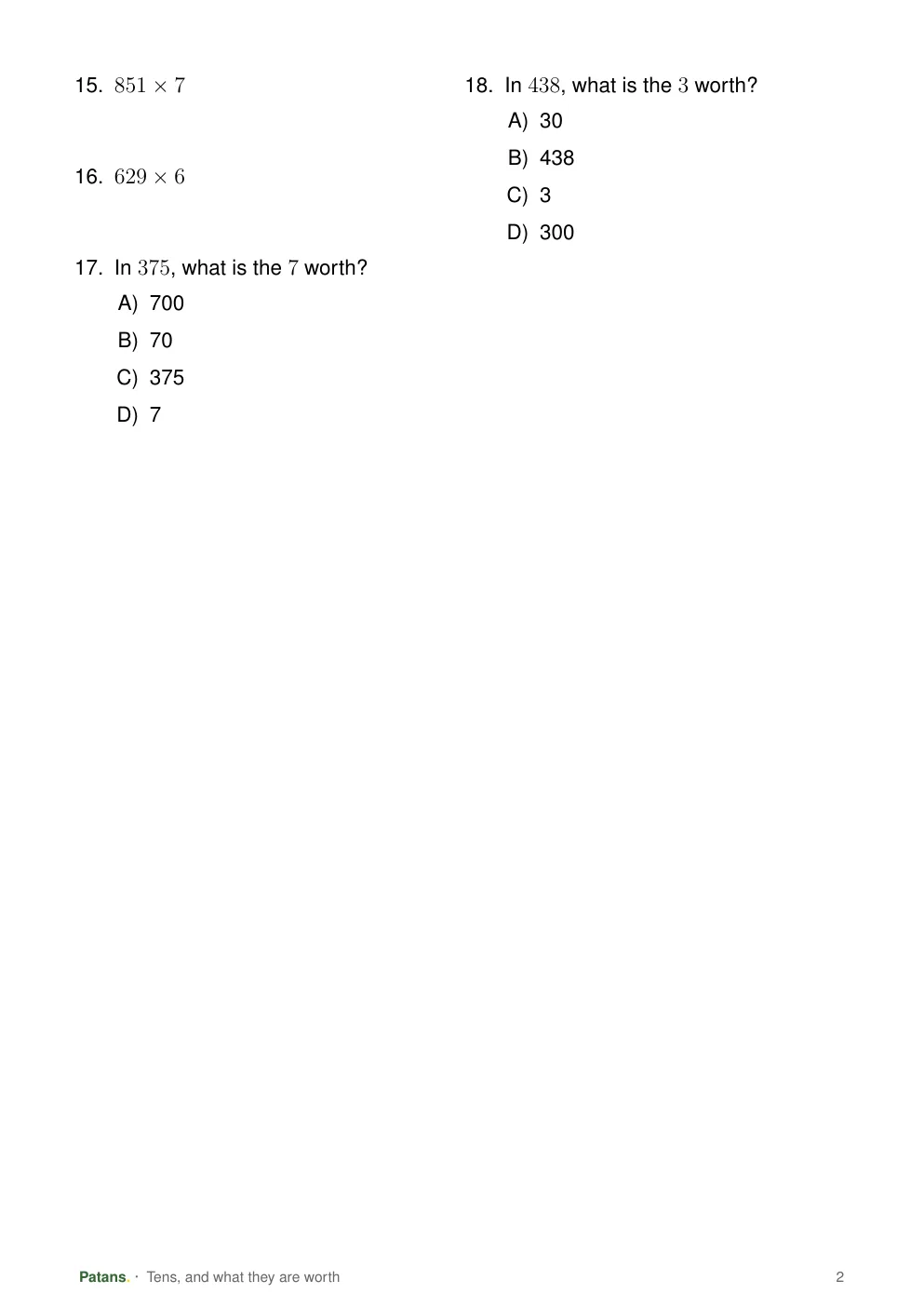
In $968$, what is the $9$ worth?
In $182$, what is the $8$ worth?
Show that you have it
The number, taken apart
$982 = 900 + \square + 2$. What goes in the box?
$681 = 600 + \square + 1$. What goes in the box?