Move a two across
Before you read anything
Sixteen fives. Lay them out — sixteen columns with five in each, or draw the rectangle.
Cut it down the middle and stand one half under the other. Count what you have before you read on.
Nothing was added
Eighty either way, and not because of a rule. The same eighty squares are on screen throughout — only standing somewhere else.
What actually moved
A two came off the sixteen and went onto the five: eight and ten. One side gave, the other took — which is why the tray keeps its size.
halved the 16 and doubled the 5
halved the 16 and left the 5 alone
Musa has half a tray. Halving is one end of the move, and the doubling is what pays for it.
Three moves
Three ways to do a multiplication that is in no table:
- Cut at the ten. $7 \times 14 = 7 \times 10 + 7 \times 4$.
- Go too far, come back. $9 \times 6 = 10 \times 6 - 6$.
- Move a two across. $16 \times 5 = 8 \times 10$.
Which one, and when
Choosing is the lesson. Look for a ten first — one to cut at, one to overshoot, or one you can make by halving an even side. If there is no ten anywhere near, the fact is small enough to know.
Check yourself
Six to try
Which of these is the same size as $12 \times 5$?
Which of these is the same size as $14 \times 5$?
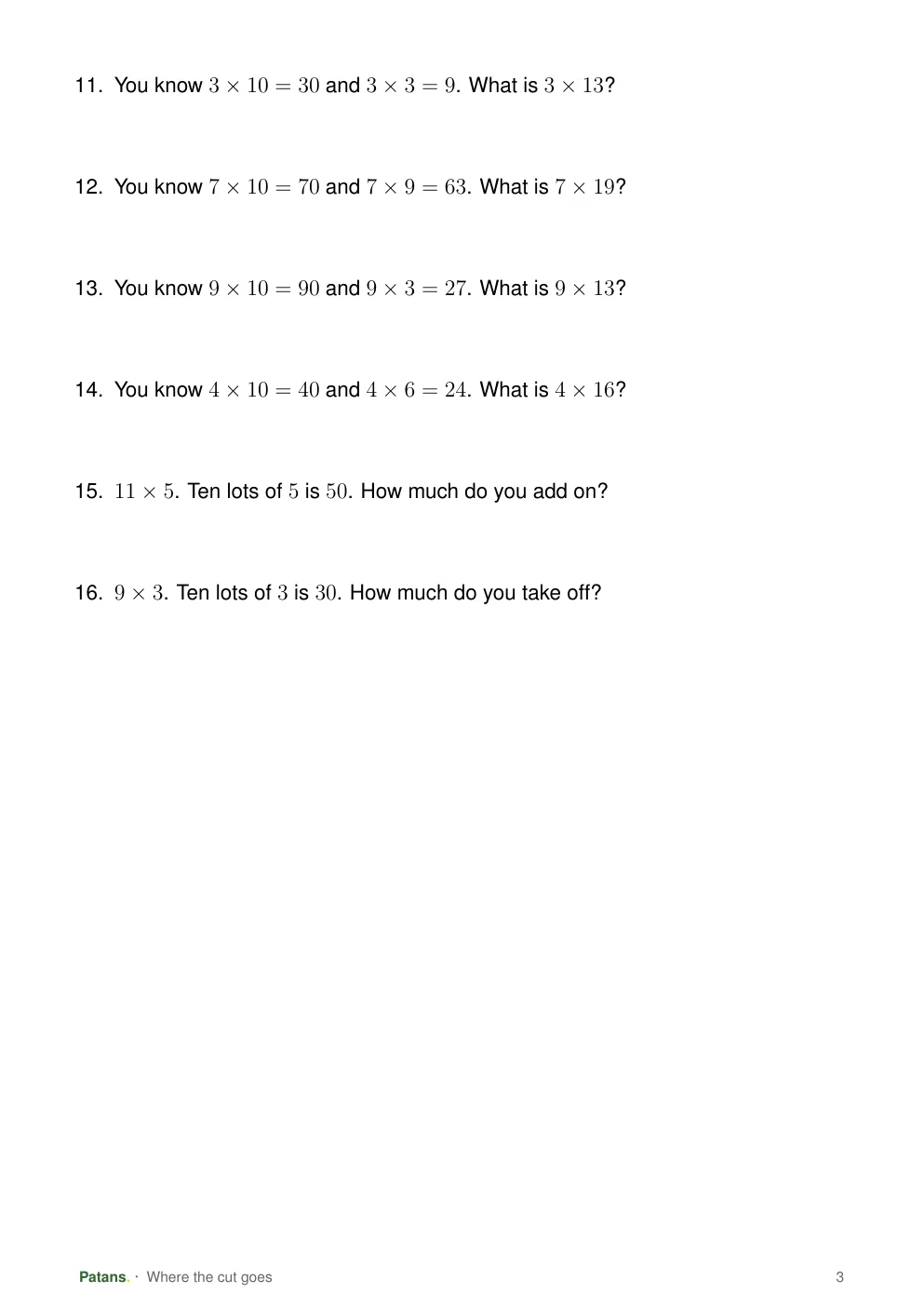
$9 \times 7$. Ten lots of $7$ is $70$. How much do you take off?
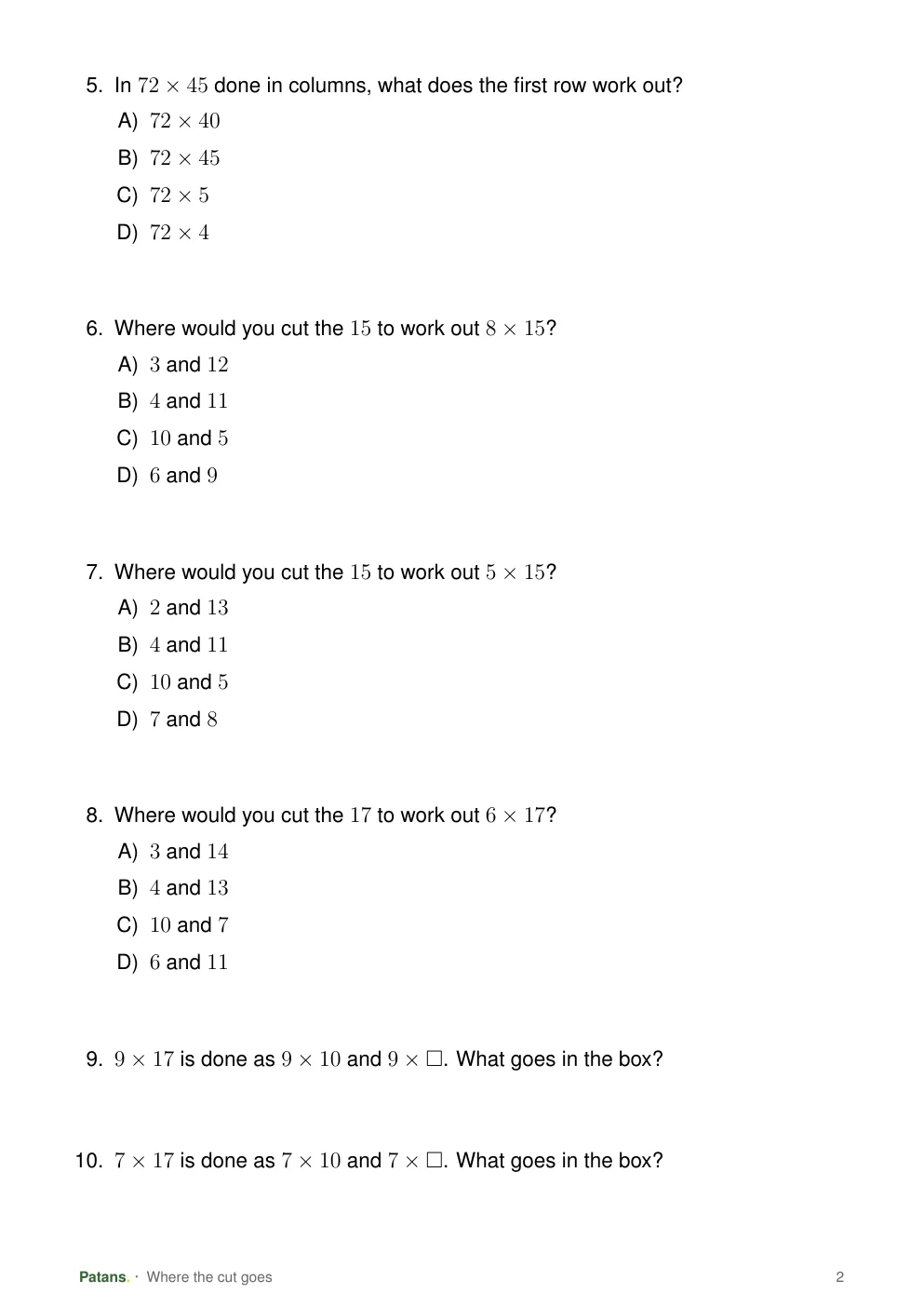
Where would you cut the $13$ to work out $4 \times 13$?
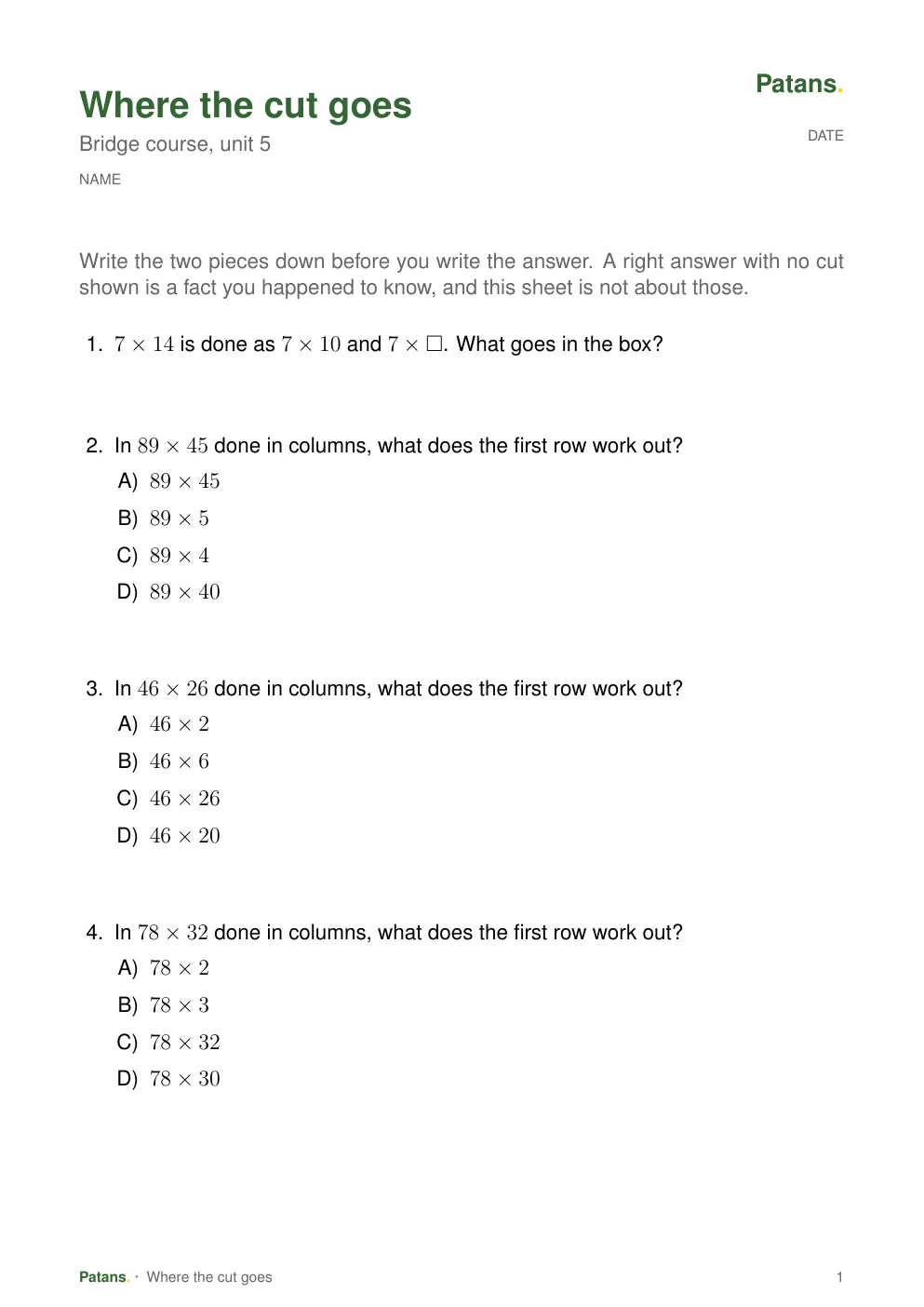
$7 \times 17$ is done as $7 \times 10$ and $7 \times \square$. What goes in the box?
You know $3 \times 10 = 30$ and $3 \times 3 = 9$. What is $3 \times 13$?
The question this leaves you with
You have worked out that $6 \times 14 = 84$.
Now somebody hands you eighty-four mangoes and asks for fourteen in each basket. How many baskets?
You need no new fact for that. You have the one you need already, standing the wrong way round.
Show that you have it
The move, chosen
Otim cuts at the ten every time. Which one does that not help him with?
Where would you cut the $15$ to work out $5 \times 15$?