The one that will not go
Before you read anything
Sixteen stones, three piles. Deal them out one at a time, the way you did in module 6.
You will be left holding one. Do not put it anywhere yet.
The one in your hand
Five each. And one that has nowhere to be.
What it is called
:x nutshell-remainder
What is left when a quantity will not split evenly. It is measured in the thing being shared — one sweet, not one child, and not one group.
Written down, that is $16 \div 3 = 5$ :remainder $1$. Two numbers, and they count different things: the five is sweets per child, and the one is sweets.
Two numbers, two jobs
said 16 divided by 3 is "5 remainder 1 children"
The one is a sweet. Nothing was left over of the children — there were three at the start and three at the end.
How big can it be?
If four were left, you could give one more to everybody. So the remainder is always smaller than the number of groups — and if it is not, the sharing was not finished.
Check yourself
Six to try
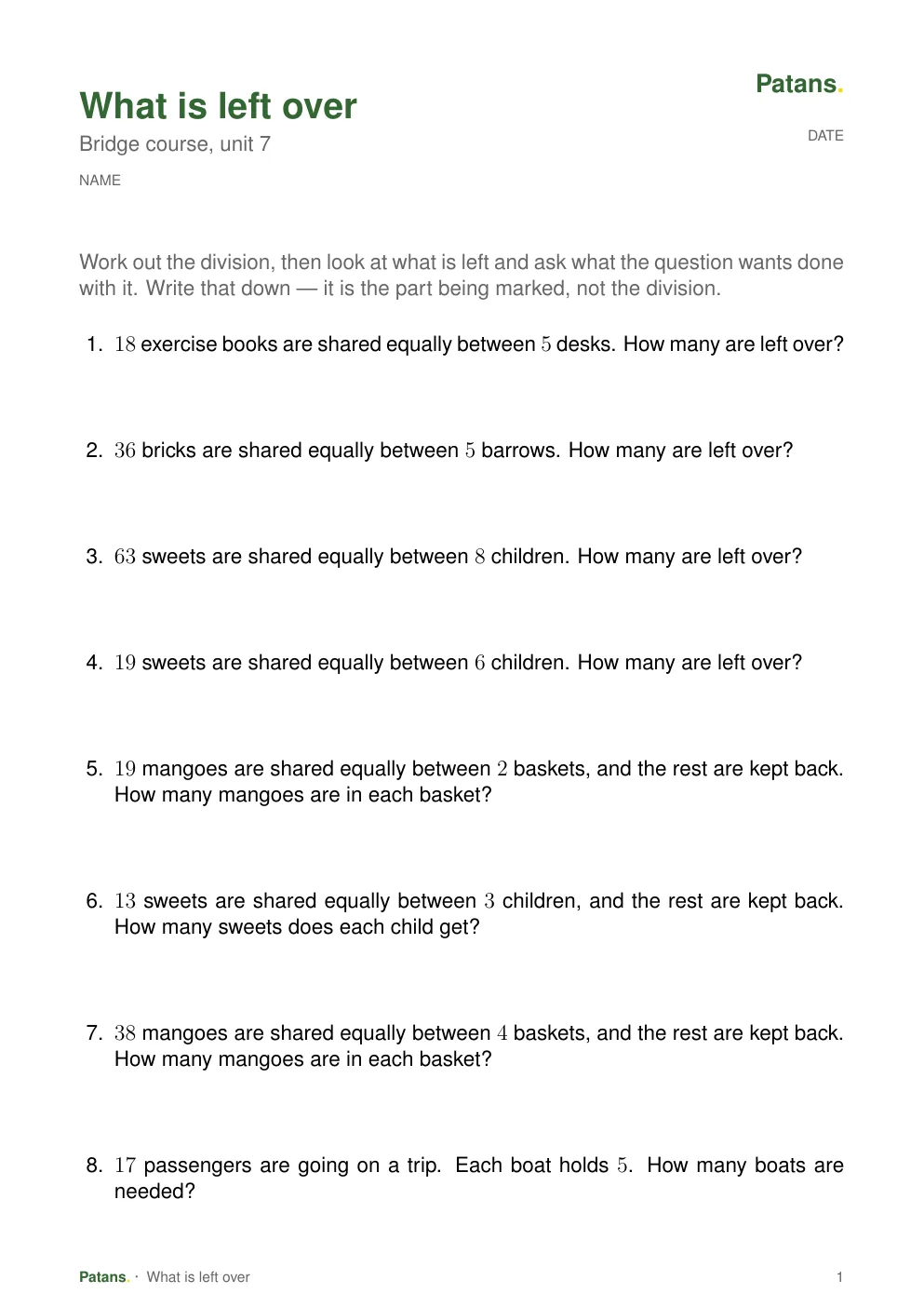
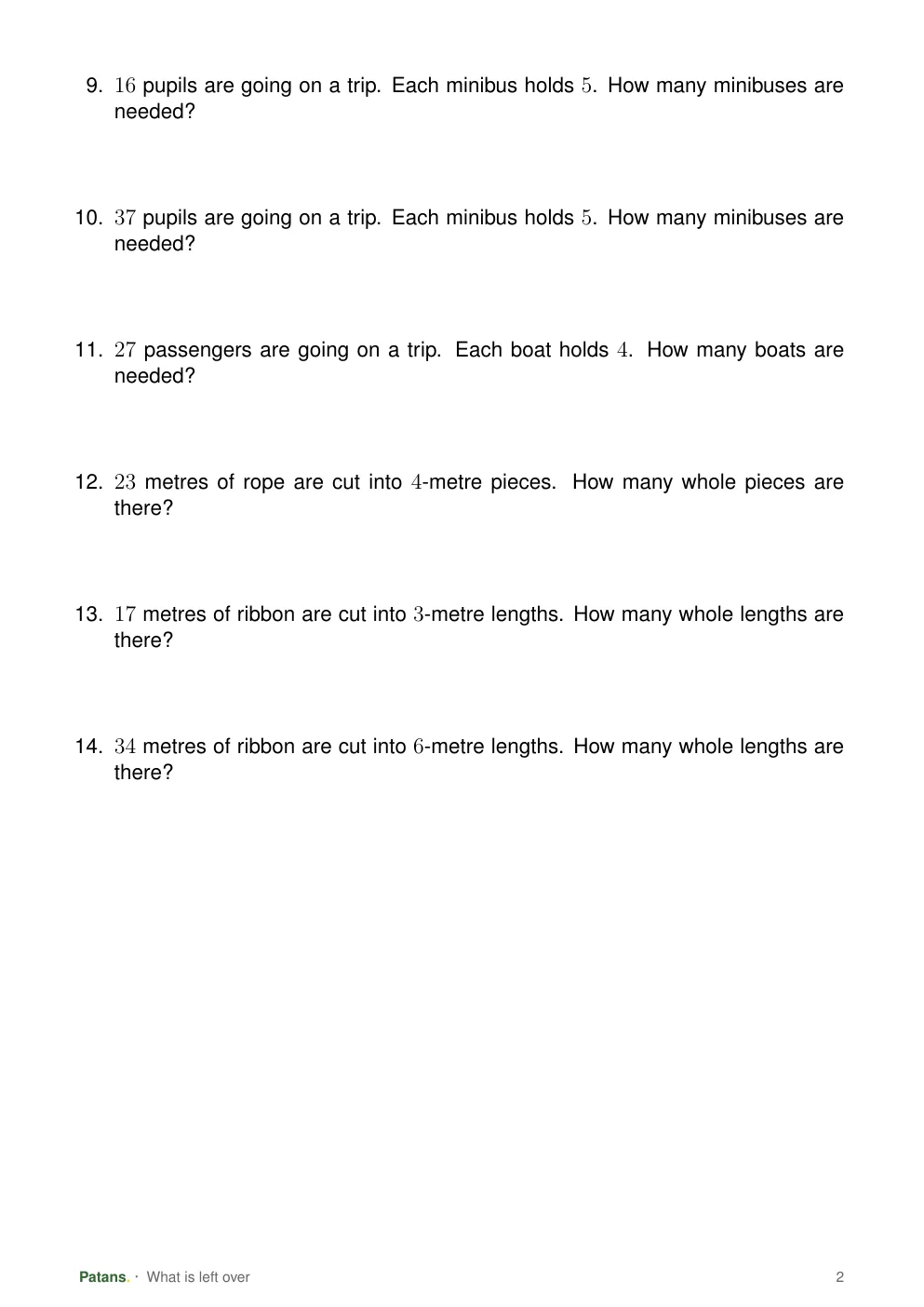
$19$ sweets are shared equally between $6$ children. How many are left over?
$18$ exercise books are shared equally between $5$ desks. How many are left over?
$63$ sweets are shared equally between $8$ children. How many are left over?
$13$ sweets are shared equally between $3$ children, and the rest are kept back. How many sweets does each child get?
$19$ mangoes are shared equally between $2$ baskets, and the rest are kept back. How many mangoes are in each basket?
$38$ mangoes are shared equally between $4$ baskets, and the rest are kept back. How many mangoes are in each basket?
Show that you have it
What the leftover is
$43$ sweets between $7$ children is $6$ remainder $1$. What is the $1$?
$17$ sweets between $5$ children is $3$ remainder $2$. What is the $2$?