The question decides
Before you read anything
$14 \div 4$. Work it out and hold the answer.
Now answer these three: how many four-seat cars for fourteen children, how many four-metre planks from fourteen metres, and how many sweets each if fourteen are split between four.
Three answers, one sum
Nothing was recalculated. The sum was done once.
What the leftover is allowed to do
:x nutshell-what-to-do-with-it
Three choices, and the situation picks: leave it out, force another whole group, or cut it up. No rule chooses for you.
- Leave it. Two metres of rope is not a plank.
- Round up. Two children still need a car.
- Split it. Two sweets between four is half a sweet each — but only if
you are allowed to cut them.
The bar knows
Draw fourteen as four equal boxes with a bit spare. That spare piece is the same picture every time; :what to do with it is a fact about sweets and rope and children, not about the bar.
learned "remainders round up" from the cars
Musa learned a rule from one example. It works until the first plank.
Check yourself
Six to try
In which of these is the answer one more than the division gives?
Otim has $57$ exercise books and hands them out $8$ at a time. How many are left at the end?
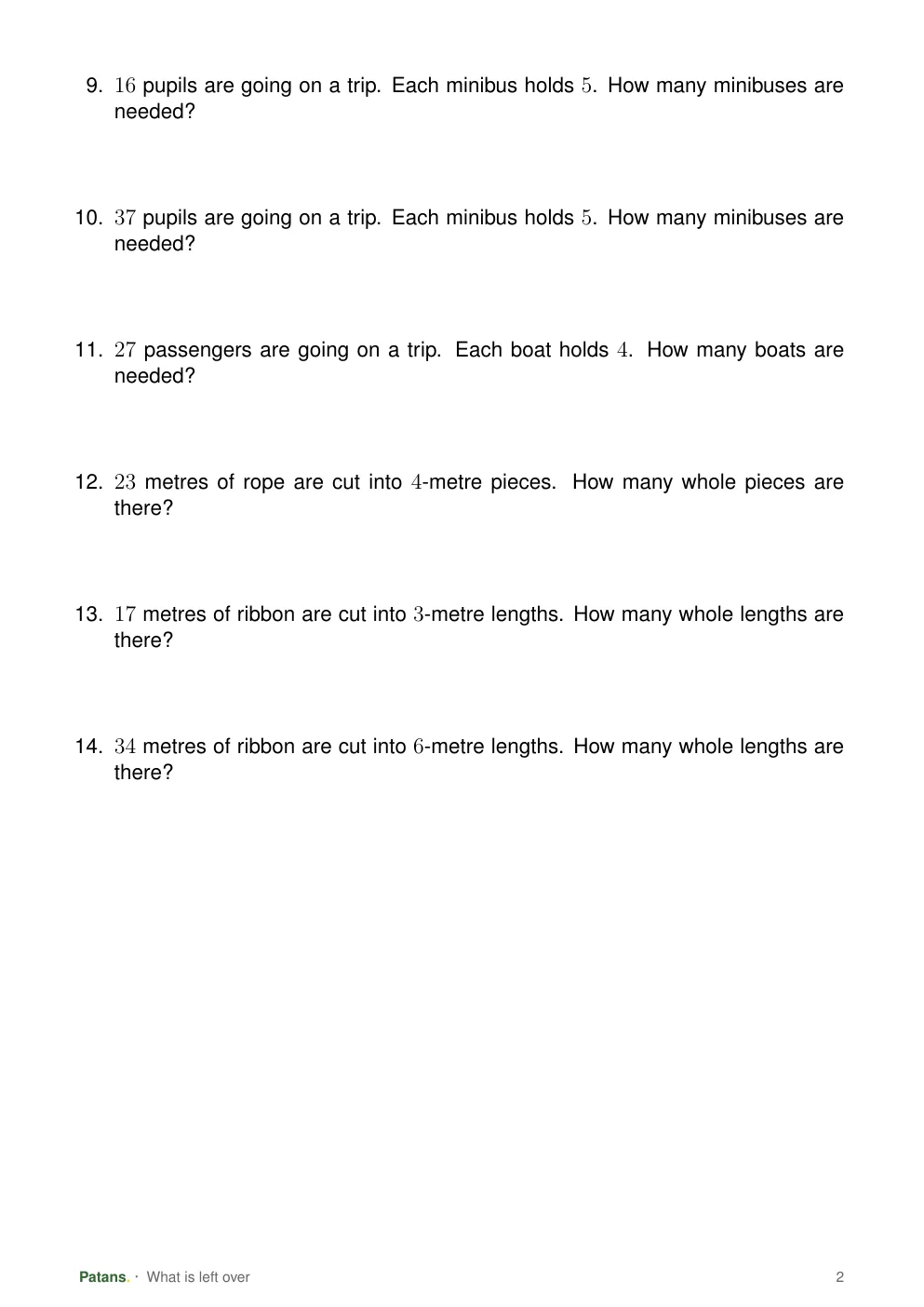
$37$ pupils are going on a trip. Each minibus holds $5$. How many minibuses are needed?
$34$ metres of ribbon are cut into $6$-metre lengths. How many whole lengths are there?
Nakato has $7$ bricks and hands them out $3$ at a time. How many are left at the end?
In which of these is the answer one more than the division gives?
The question this leaves you with
$347 \div 8$.
You know exactly what to do — but not in your head, and not with counters either. The same is true of $347 + 285$, and of $47 \times 26$.
The numbers have outgrown you. What do you do when that happens?
Show that you have it
Same sum, different job
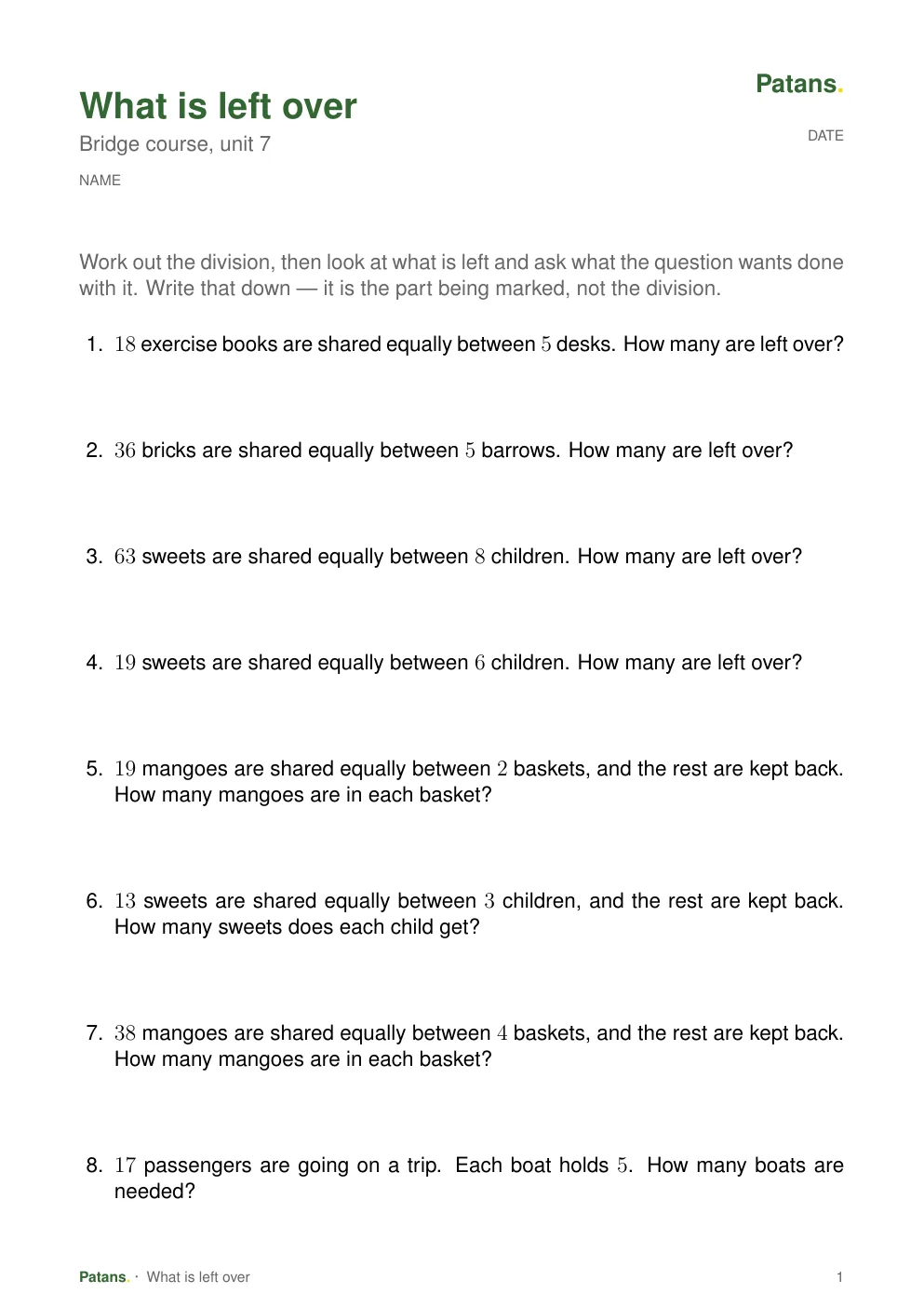
$36$ bricks are shared equally between $5$ barrows. How many are left over?
$43$ sweets between $7$ children is $6$ remainder $1$. What is the $1$?