The same amount, cut again
Before you read anything
Fold a strip in half and shade one half. Now fold the whole strip into sixths without unshading anything.
Count the shaded sixths. You did not change the shading.
The lines arrive; the shading does not move
One half and three sixths are the same amount. They are one bar, said twice.
Why the rule is the rule
:x nutshell-equivalent
Two fractions that describe the same amount. The bar did not change; only the number of cuts did.
Cutting every piece into three makes three times as many pieces, and each one is a third of the size. So the count on top triples and the size on the bottom triples — which is why you multiply both.
:Equivalent fractions are not a rule about two fractions. They are a fact about one bar.
The mistake the rule invites
turned $\frac{1}{2}$ into $\frac{3}{4}$ by adding 2 to each
Adding the same to both changes the amount. Cutting is multiplying — every piece becomes the same number of smaller pieces — and adding is not cutting at all.
Backwards, too
$\frac{6}{8}$ is three pairs out of four pairs, which is $\frac{3}{4}$. Bigger pieces, fewer of them, same bar.
Check yourself
Six to try
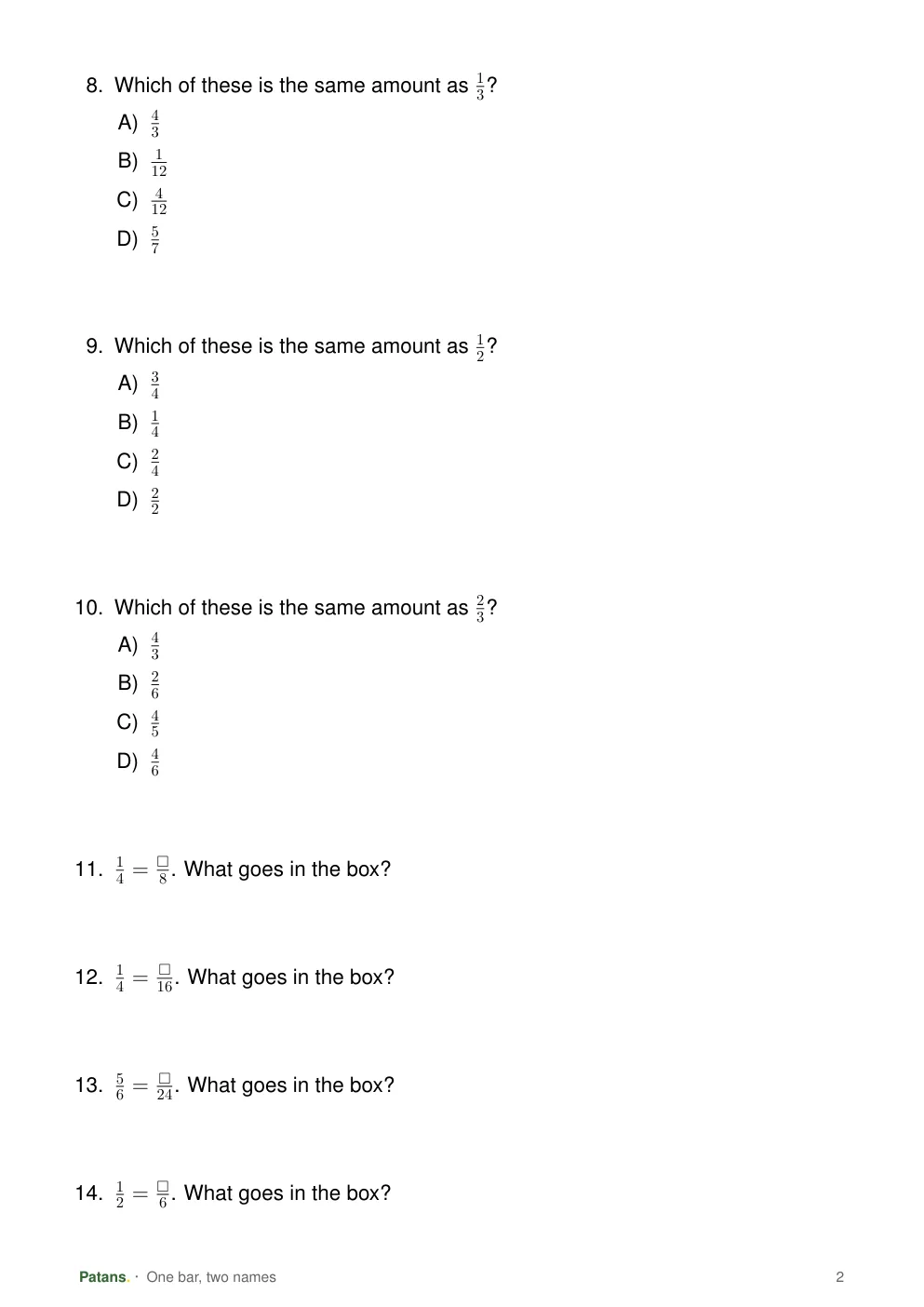
Which of these is the same amount as $\frac{1}{2}$?
$\frac{1}{2} = \frac{\square}{6}$. What goes in the box?
Which of these is the same amount as $\frac{1}{3}$?
$\frac{1}{3} = \frac{\square}{9}$. What goes in the box?
$\frac{2}{3} = \frac{4}{\square}$. What goes in the box?
$\frac{2}{8}$ written with as few pieces as possible is $\frac{\square}{4}$. What goes in the box?
The question this leaves you with
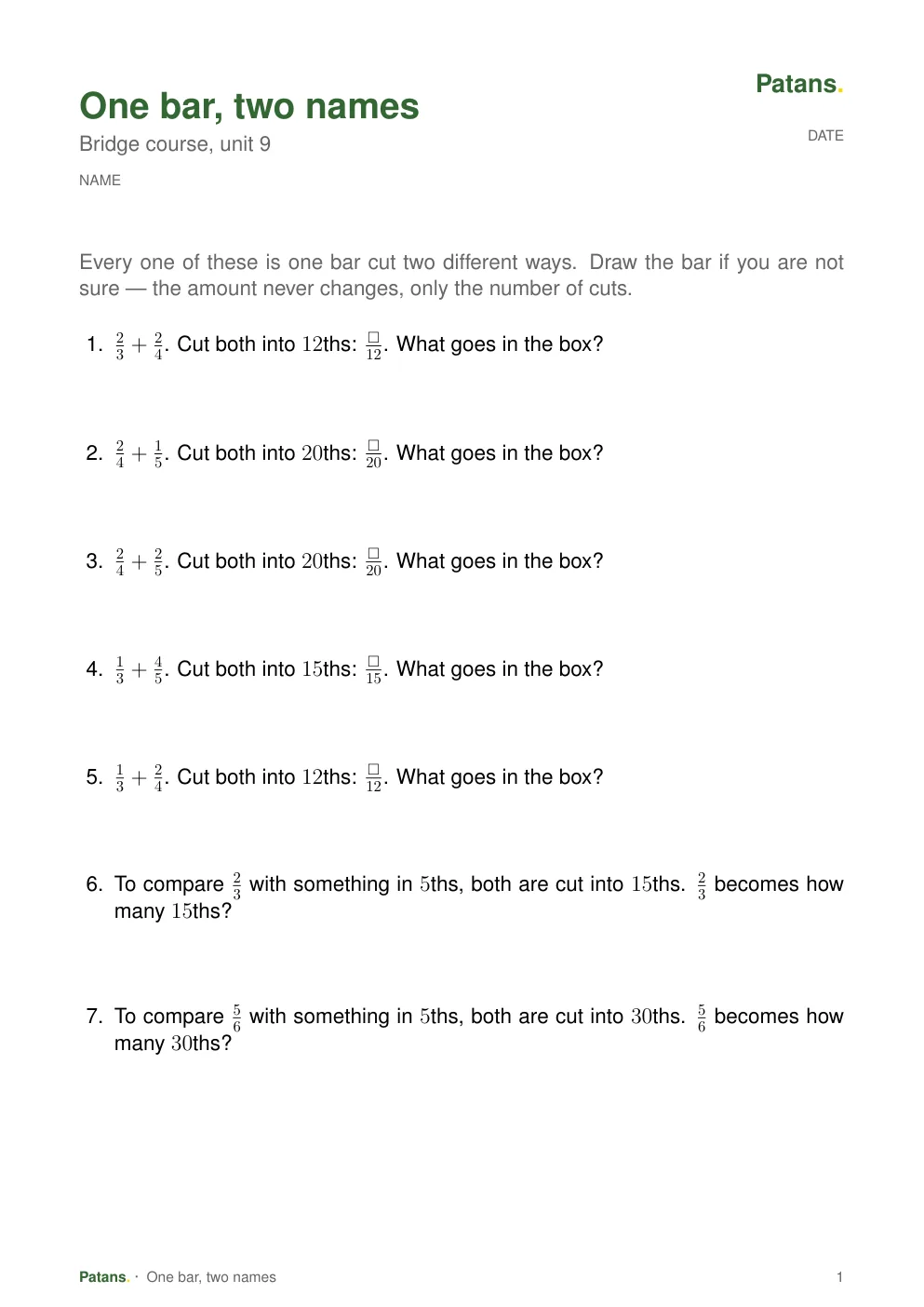
$\frac{2}{3}$ or $\frac{3}{5}$ — which is more?
You cannot cut one into the other, because three does not go into five. And counting does not help: three is more than two, and fifths are smaller than thirds, so the two numbers pull opposite ways.
So how do you compare them at all?
Show that you have it
Cutting, not adding
Every piece of $\frac{1}{2}$ is cut into $3$, giving $\frac{3}{6}$. What changed?
$\frac{4}{5} = \frac{8}{\square}$. What goes in the box?