Bonds without thinking
Sixty seconds
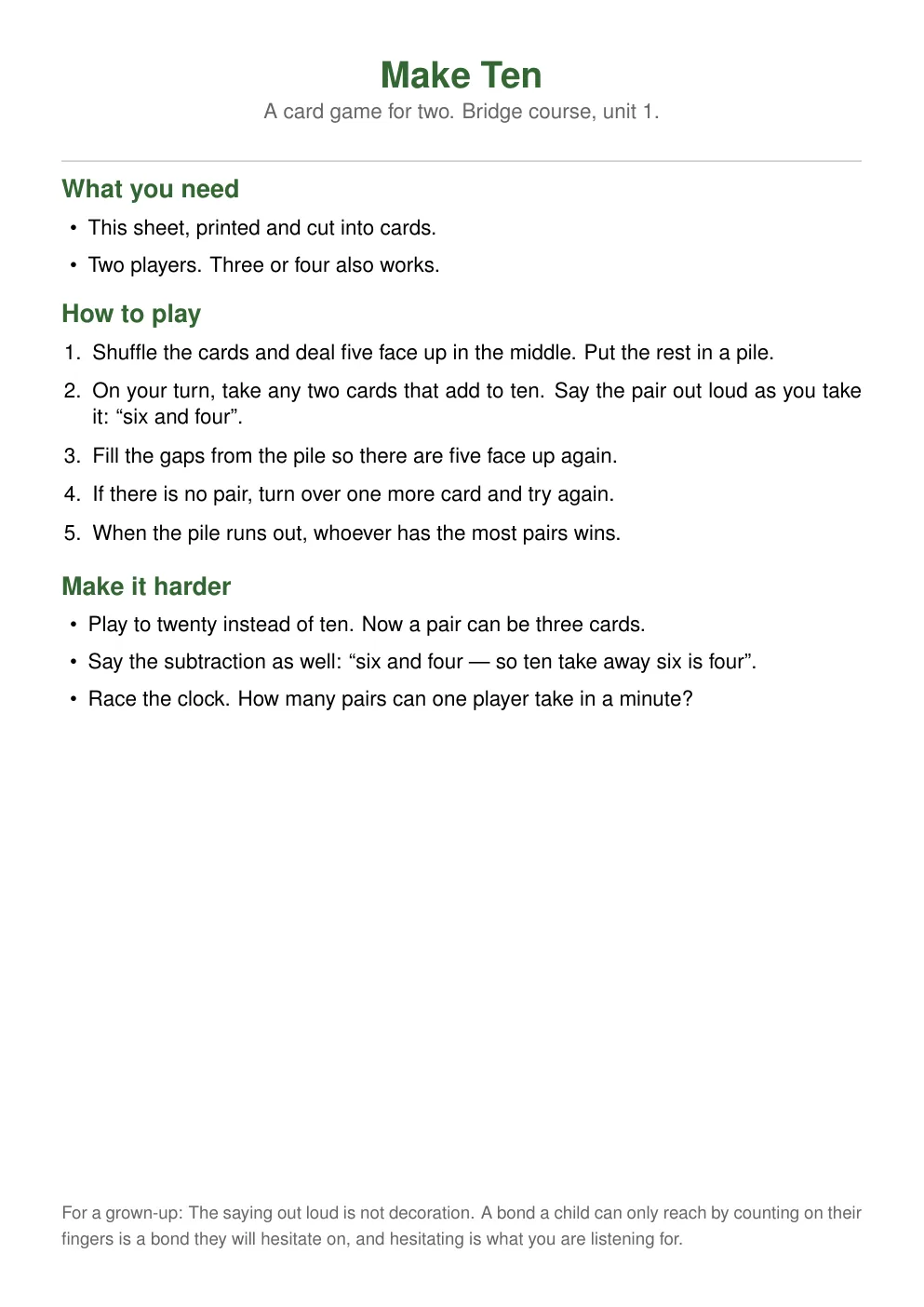
Sixty seconds, three lives. Play it three times and write down your three scores.
Read what it says
Before you start, one thing about how to play this.
Play it three times. Not thirty. Three rounds, then stop and come back
tomorrow. Practice works when it is short and often, because your memory needs
to half forget something before being asked again — and that cannot happen
inside one sitting.
While you play, notice where you slow down. You will not hesitate evenly.
Almost everyone is quick on doubles, and quick on anything that makes ten, and
slow on the same handful. Six and seven. Thirteen take away five. Fifteen take
away eight.
Write down the three you keep pausing on. Those three are your whole practice
list. Practising the ones you already know feels productive and changes
nothing.
That is it. Go and play.
Play it three times, not thirty. Then stop, and come back tomorrow.
What the bonds are for
Take the 8 up to 10 first. It needs 2. The 2 comes out of the 7, which leaves 5 — so $8 + 7$ has quietly become $10 + 5$, and nobody adds $10 + 5$ the hard way.
That move has a name — it is :making ten — and it is the reason a :number bond is worth having by heart rather than working out.
:x nutshell-making-ten
Filling one number up to 10 by taking what it needs from the other. The total never changes: you are moving part of one pile across, not adding anything.
:x nutshell-number-bond
A whole cut into two parts, and the two parts that make it. Seven is four and three, and it is also five and two.
That is the whole reason the bonds are worth knowing. You cannot take the 2 out of the 7 if you have to work out what 7 is made of first.
Watch what you slow down on
The pause is the information. Write down the three bonds you keep hesitating on. Those three are your whole practice list.
every single time, on 7 and 6
Everybody has three of these. Knowing which three is most of the work.
Five minutes a day for about two weeks, for most learners — not one long afternoon, however hard the afternoon. Recall is built by being asked again after you have half forgotten.
Check yourself
Six, timed
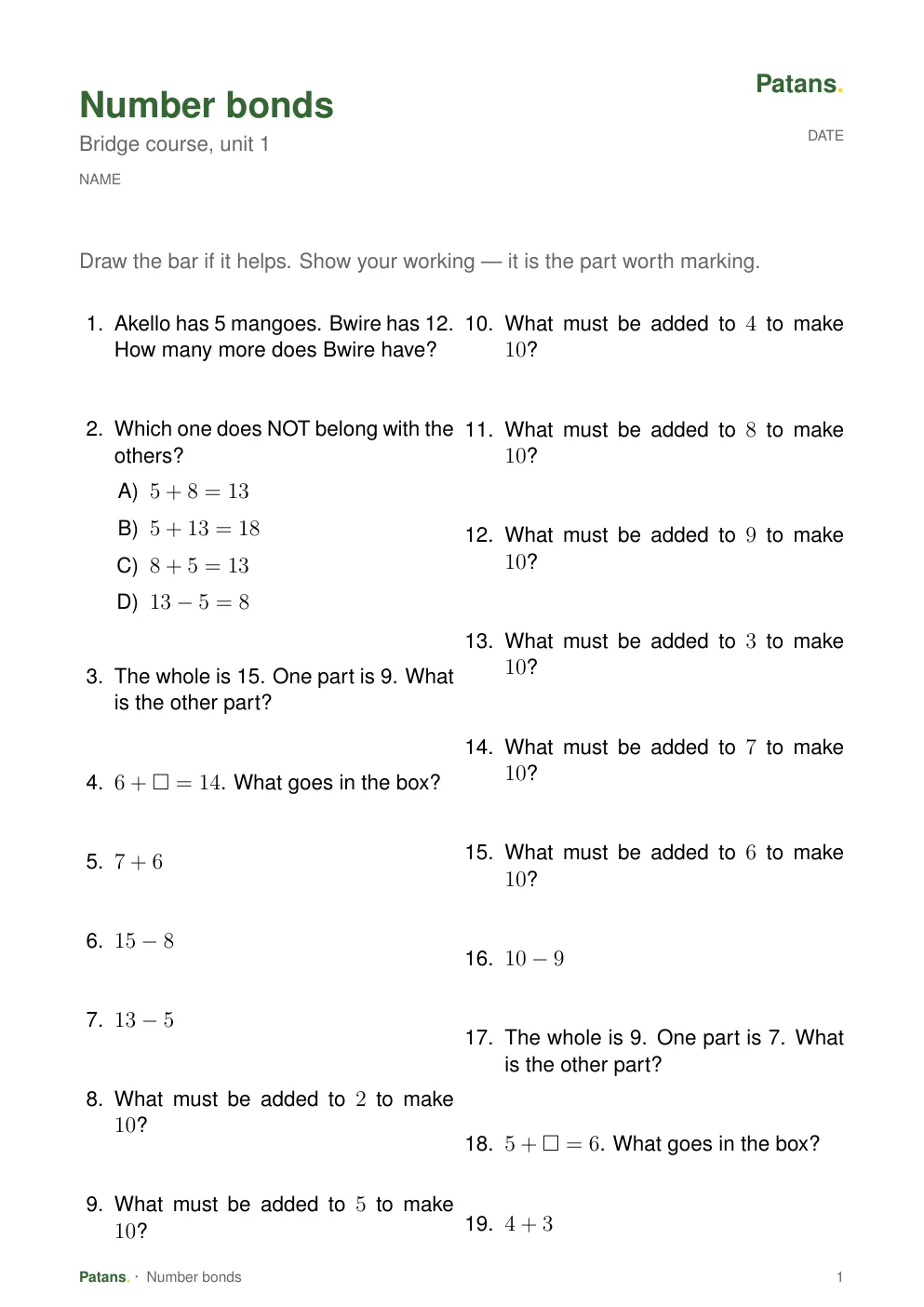
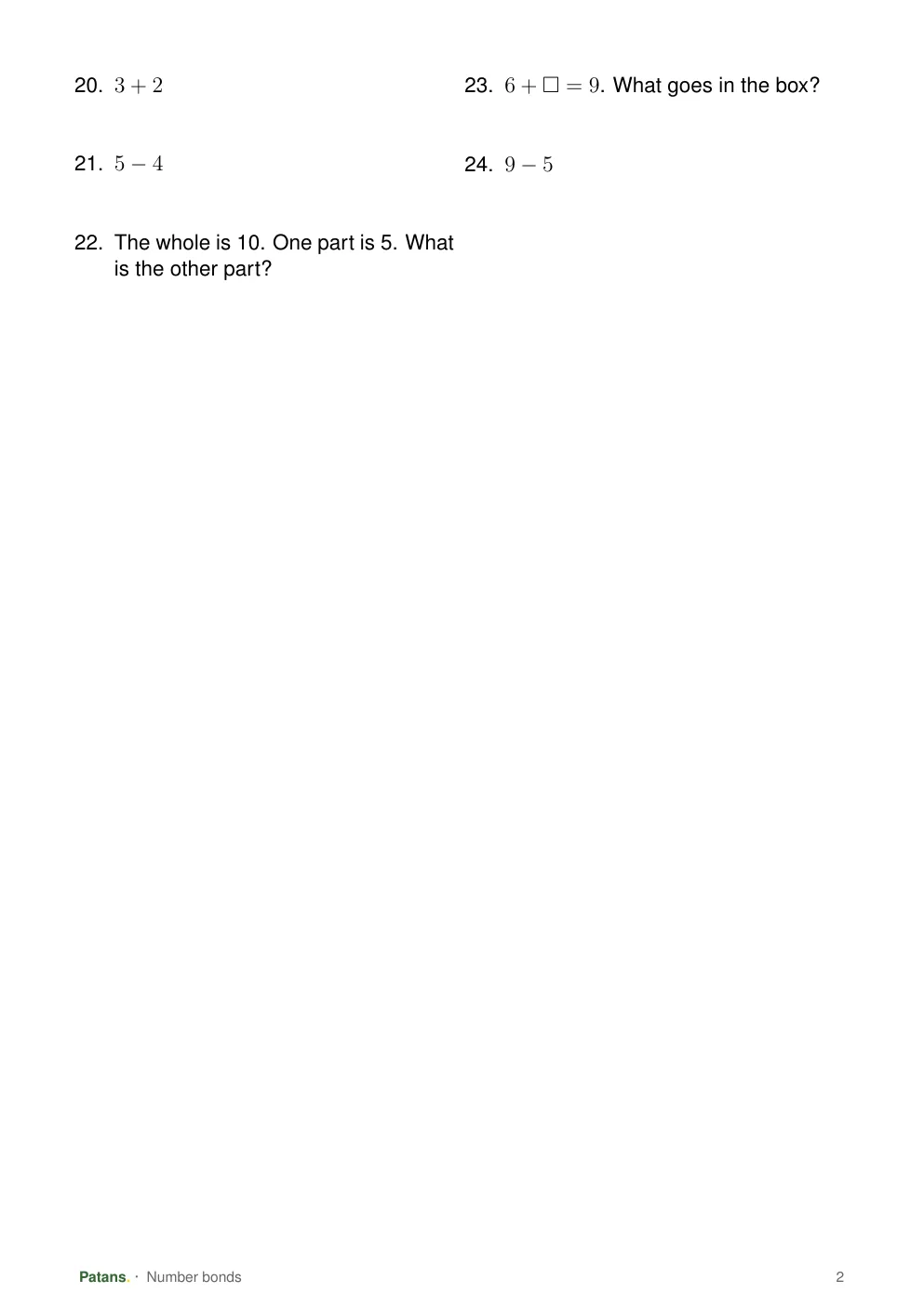
Akello has 5 mangoes. Bwire has 12. How many more does Bwire have?
Which one does NOT belong with the others?
The whole is 15. One part is 9. What is the other part?
$6 + \square = 14$. What goes in the box?
$7 + 6$
$15 - 8$
Show that you have it
Making ten, step by step
$8 + 5$. Which is less work?
$9 + 5$. Which is less work?
You know $5 + 6 = 11$. What is $65 + 6$?
$6 + 7$. Which is less work?