Ten does the work
Before you read anything
Two rows of ten, and fifteen stones. Draw two rows of ten boxes. Put 8 stones in the first row and 7 in the second.
Now fill the first row. Do not count anything — just move stones across until the top row is full.
Look at what is left in the bottom row, and read the answer off the picture.
The fifteen you laid out
What you actually did
You did not add $8 + 7$. You moved two stones — >watch the two cross over — and then read $10 + 5$, which nobody has to work out.
But how did you know it was two?
Because eight needs two — and that is a :number bond, which you already have. That is the pause module 1 ended on, gone — you read the parts off instead of working them out. That is the whole reason the bonds were worth learning: they are what makes the move possible without stopping to think.
:x nutshell-number-bond
A whole cut into two parts. Seven is four and three, and it is also five and two.
Every sum that crosses ten works the same way. Fill up to ten, and add what is left over.
Now do it yourself
Ten counters and a divider. Drag it and watch what each number needs to reach ten — that is the only fact this method runs on.
The numbers get bigger and nothing changes
$48 + 7$. The eight still needs two, the two still comes out of the seven, and $50 + 5$ is still not a sum anybody has to do.
This is the test of a method. Counting on works for $8 + 7$ and falls apart at $48 + 7$. Filling up to ten does not care how big the tens are.
Check yourself
Six to try
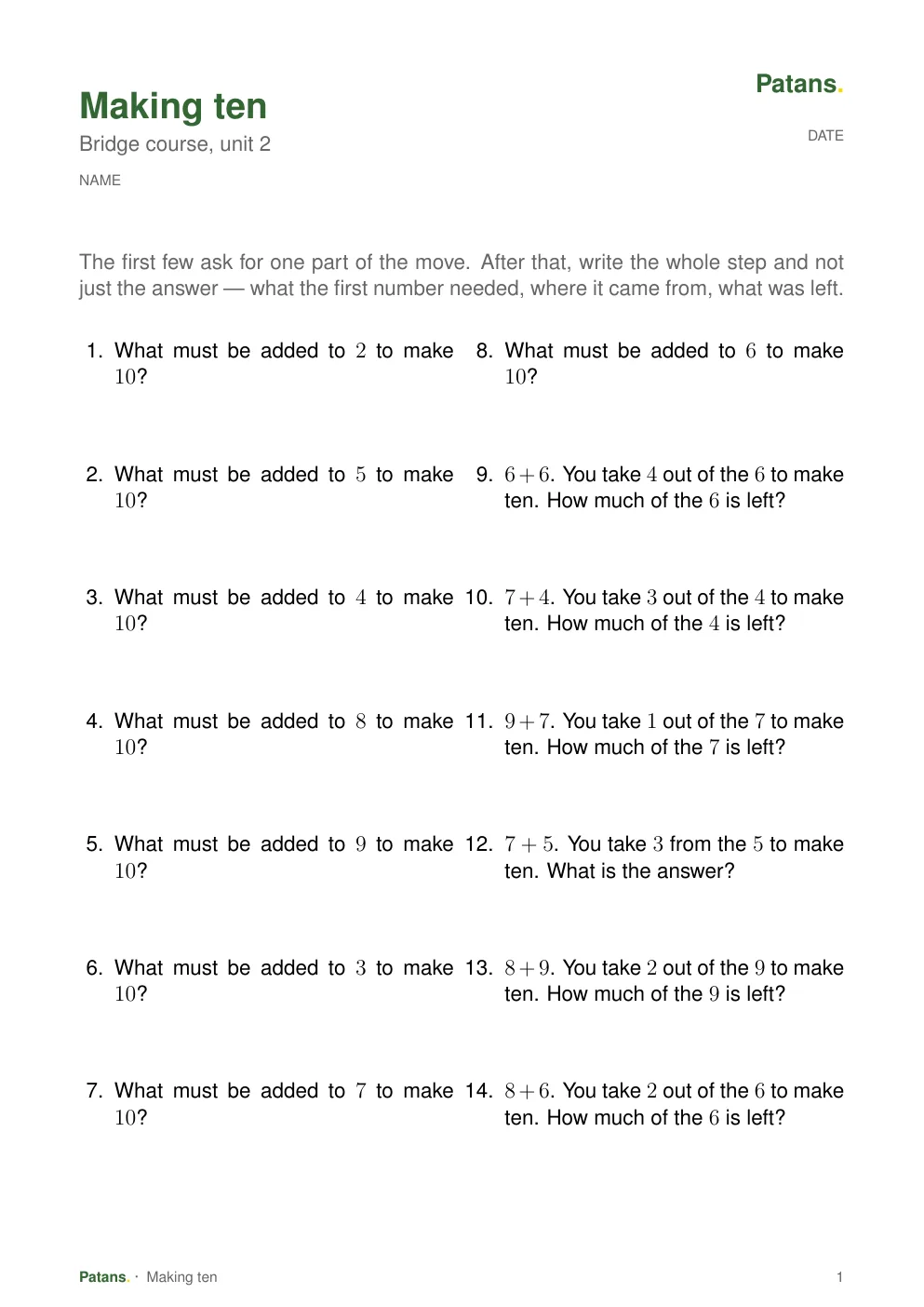
What must be added to $2$ to make $10$?
Which of these is $8 + 5$, done by making ten?
Which of these is $9 + 6$, done by making ten?
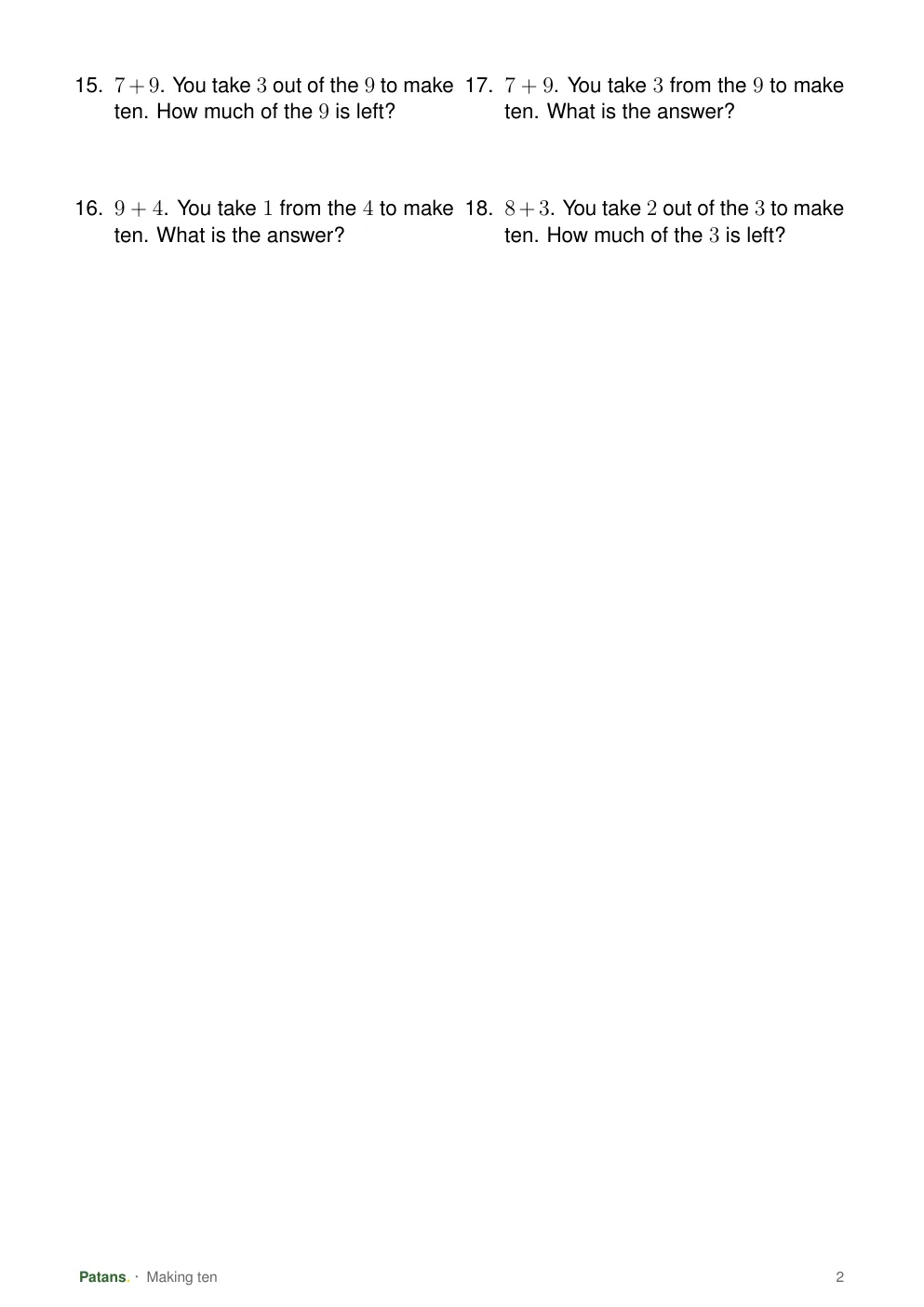
$7 + 9$. You take $3$ out of the $9$ to make ten. How much of the $9$ is left?
Which of these is $7 + 7$, done by making ten?
$7 + 6$
Show that you have it
One fact, and the ones it hands you
You know $7 + 9 = 16$. What is $67 + 9$?
You know $9 + 8 = 17$. What is $29 + 8$?