Go one too far
Before you read anything
Nine sixes. Do not work it out. Count out ten sixes instead — ten small piles with six in each.
Now take one pile away. Say what you took, out loud, in two words.
Ten is always easier than nine
You went past on purpose and came back. Nobody counted in nines.
You have done this before
:x nutshell-compensation
Doing an easier sum than the one you were asked, then paying back the difference. The paying back is not optional, and it is not always one.
Module 2 did $47 + 29$ as $47 + 30 - 1$. That is :compensation, and this is the same move one operation up. Nothing here is new — it has only been pointed at something bigger.
What comes off is one *lot*
worked out 60, then wrote 59
Otim took away one. The thing he did not want was one six, and one six is six.
Say it to yourself every time: ten sixes, take one six. Never take one.
The other direction
$11 \times 7$. Ten sevens is seventy, and you are one seven short — so seventy-seven. Going past and coming back works going the other way round, and it is the same picture with a column added instead of removed.
When this is the wrong move
Cutting at the ten and going past it use the same easy row. Which you reach for depends on which side of it your number sits — and if it is nowhere near a ten, neither helps.
Check yourself
Six to try
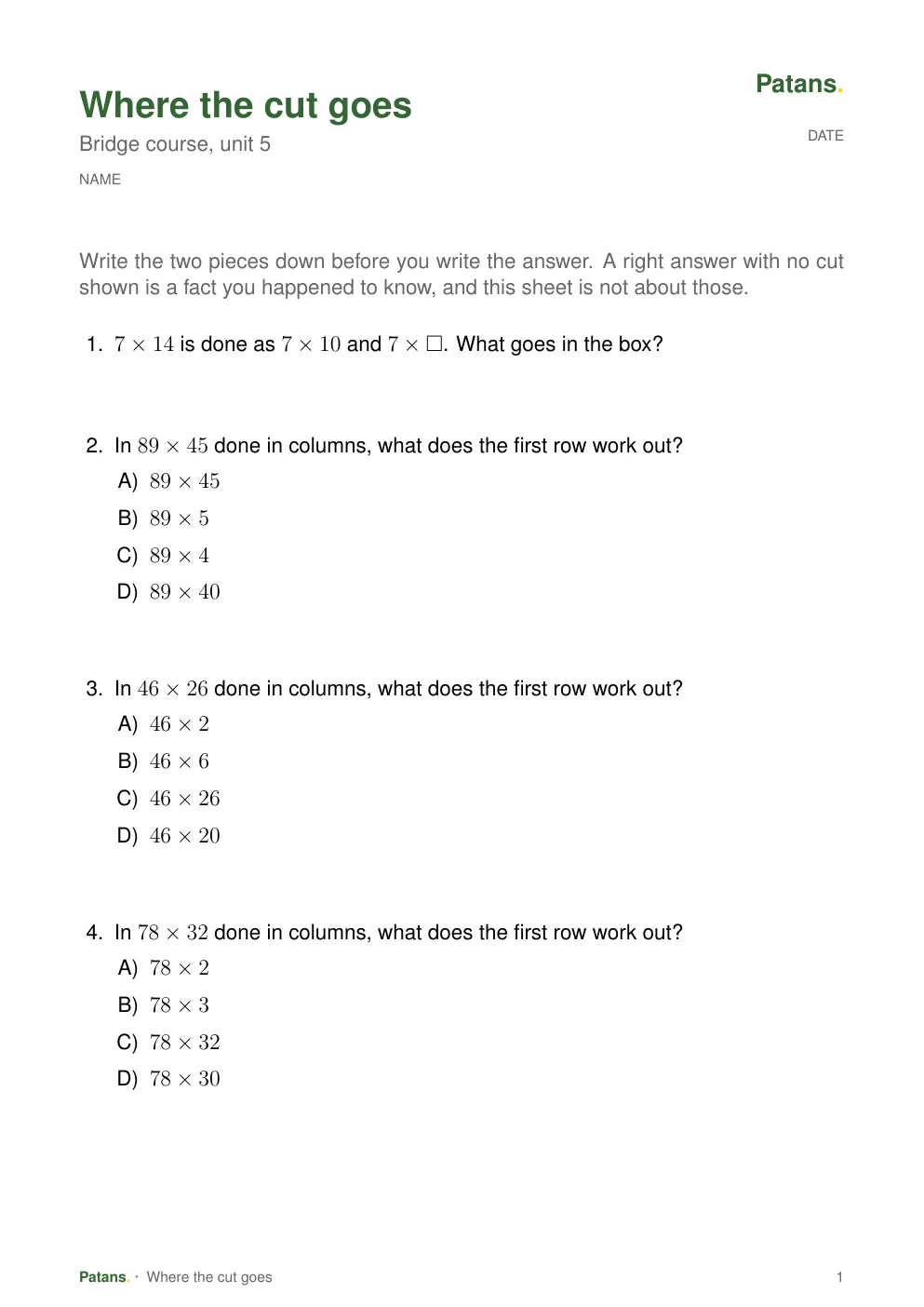
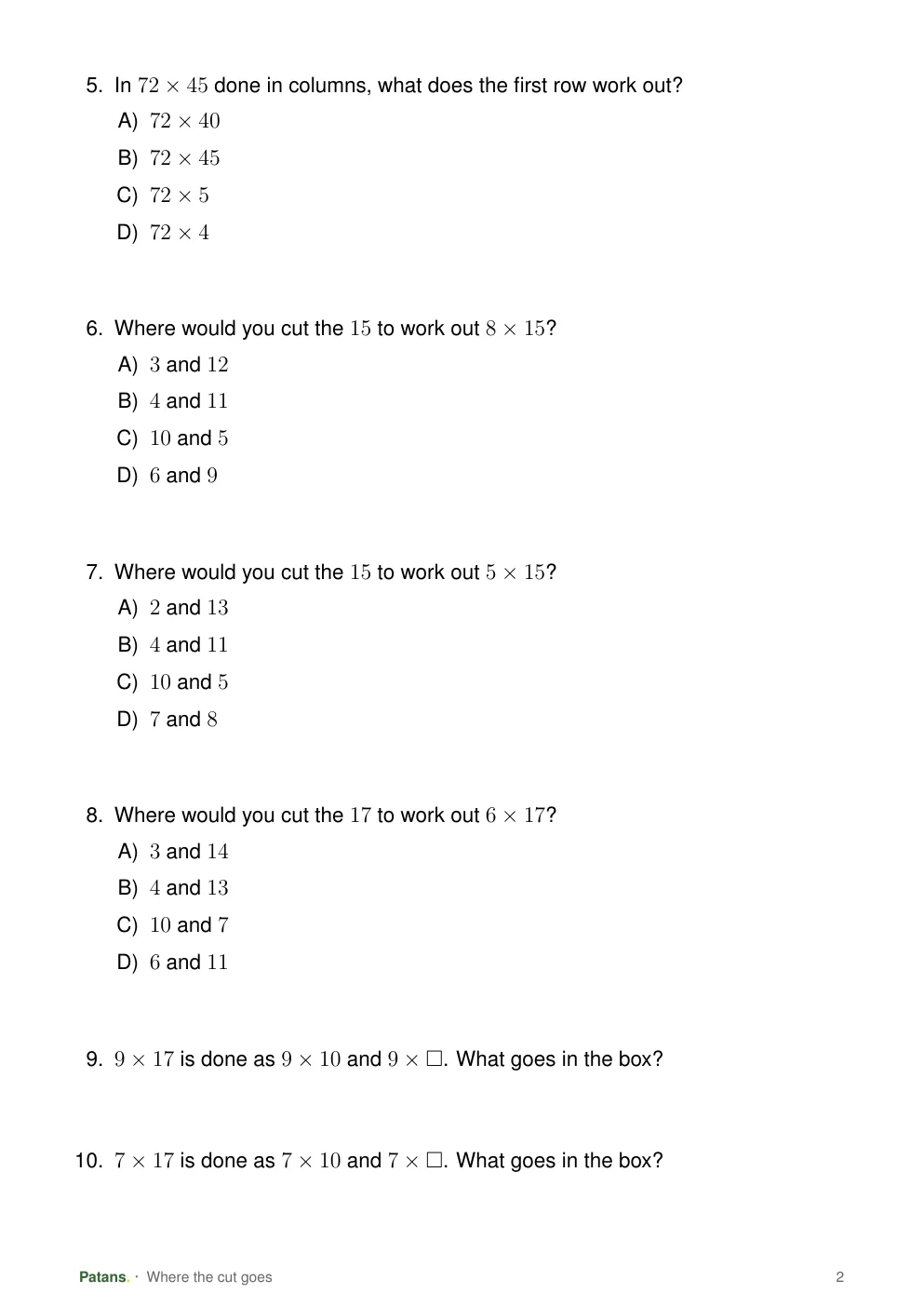
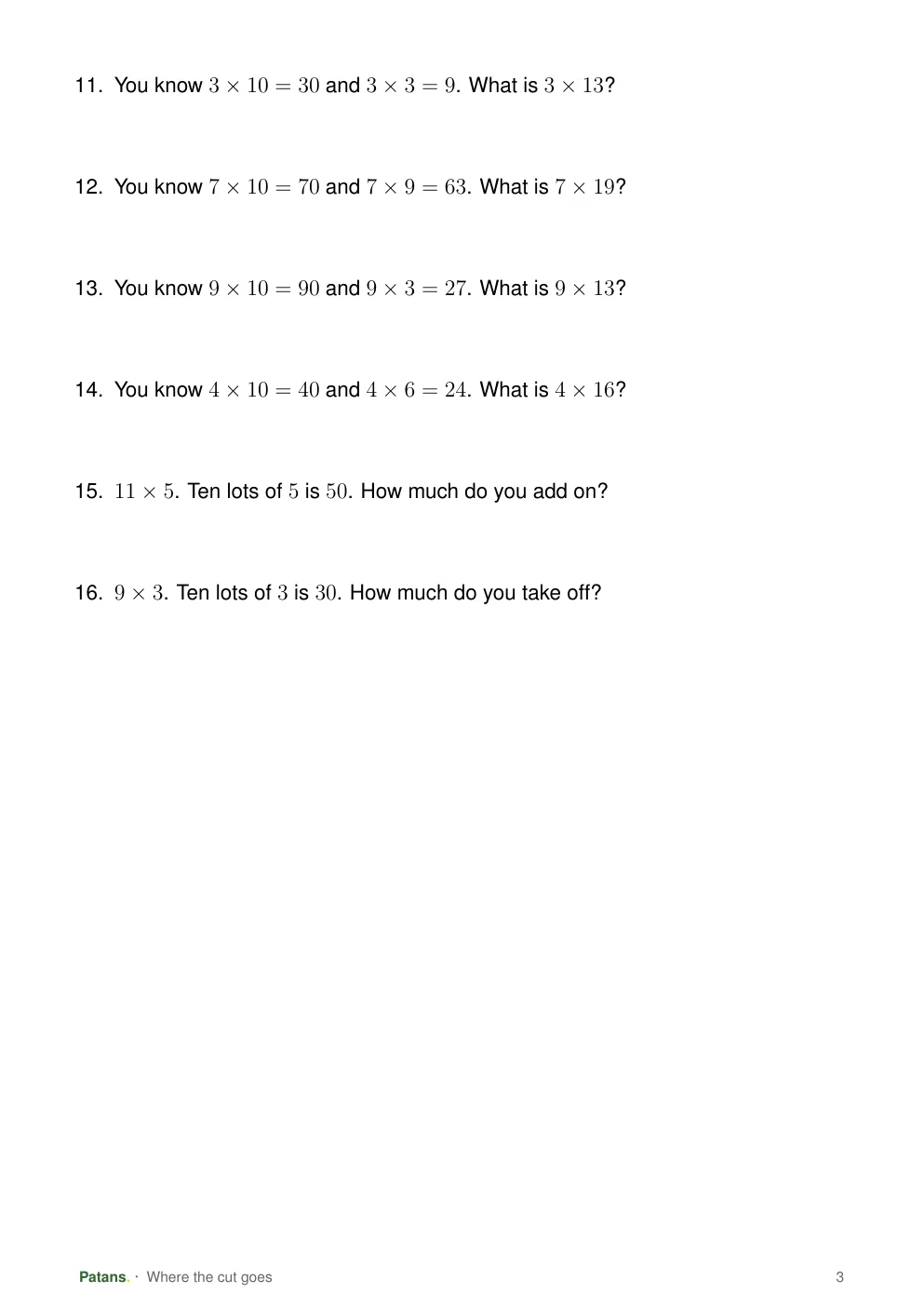
$9 \times 3$. Ten lots of $3$ is $30$. How much do you take off?
$9 \times 7$. Ten lots of $7$ is $70$. How much do you take off?
$11 \times 5$. Ten lots of $5$ is $50$. How much do you add on?
$11 \times 3$. Ten lots of $3$ is $30$. How much do you add on?
You know $7 \times 10 = 70$ and $7 \times 9 = 63$. What is $7 \times 19$?
You know $9 \times 10 = 90$ and $9 \times 3 = 27$. What is $9 \times 13$?
Show that you have it
The one it does not help with
Otim cuts at the ten every time. Which one does that not help him with?
You know $3 \times 10 = 30$ and $3 \times 3 = 9$. What is $3 \times 13$?