One split, four facts
Before you read anything
Seven things, two piles. Find seven small things — bottle tops, stones, beans. Put them in two piles. Any two piles.
Now write down every true number sentence your two piles say. Most people write two. There are four.
What you just made
Start here
Watch a seven split
A number bond is a whole cut into two parts. Cut 7 into 4 and 3, and you have not learned one fact. You have learned four.
put hers in 4 and 3
put his in 5 and 2
Both of them are right, and neither has more seven than the other.
Now do it yourself
The same seven, on the screen. Drag the line through them and watch the four sentences change together — you are only moving one thing.
Read the picture four ways
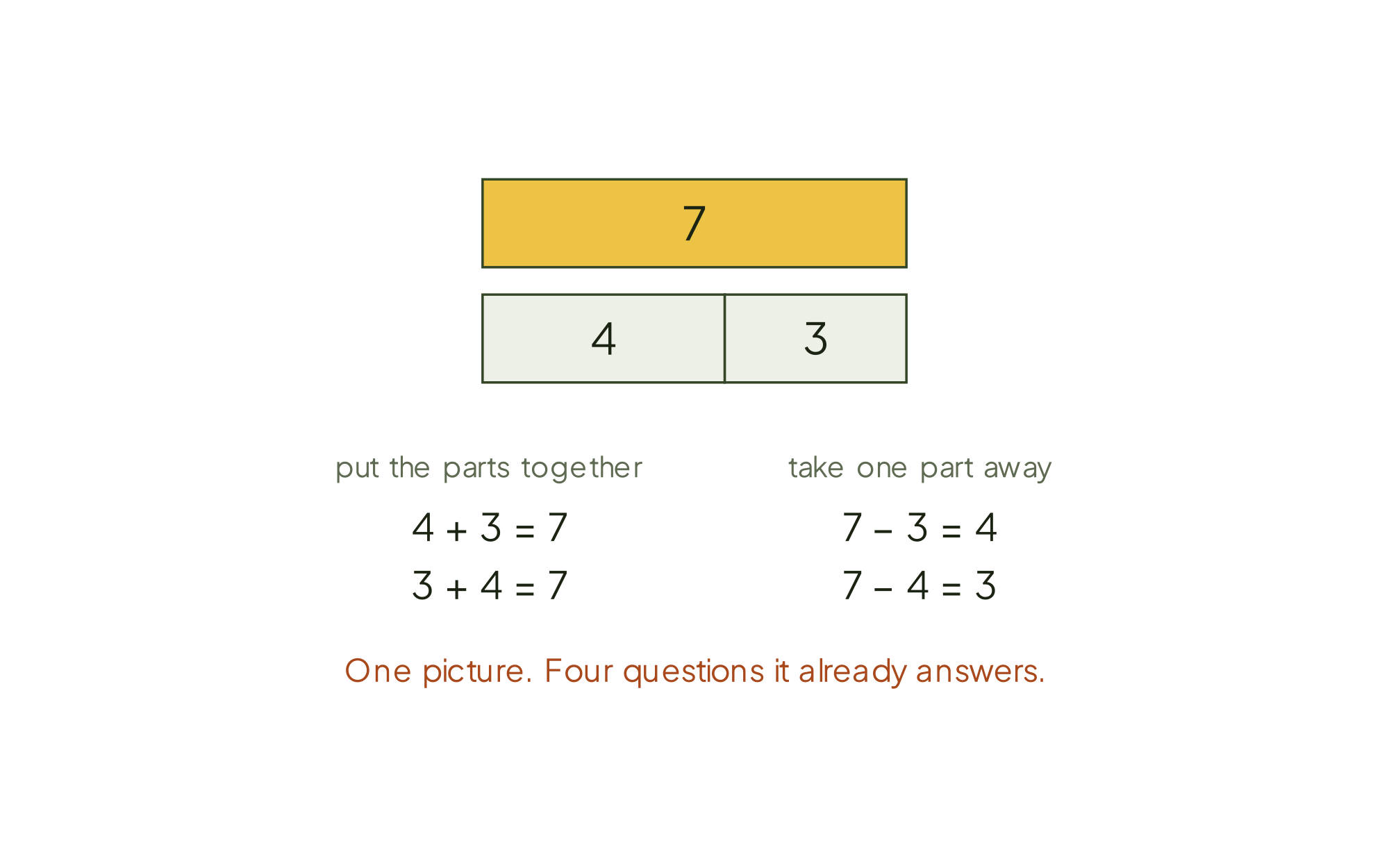
Going down the picture is adding: put the parts together. Going up is subtracting: take one part off the whole and the other part is what is left.
Why "family". The four sentences are relatives. They come from one split, so knowing any one of them means you already know the other three.
Check yourself
Six to try
The whole is 15. One part is 9. What is the other part?
$6 + \square = 14$. What goes in the box?
Which of these is NOT one of the facts in the split $12 = 7 + 5$?
Amara knows $9 + 6 = 15$. Which of these can she write down straight away, with no working?
Which split has two equal parts?
Which of these is true for every part-whole split?
Show that you have it
One fact, and the three that came free
You know that $47 + 28 = 75$. Without working anything out: $75 - 28 = \square$
Same split. Without working anything out: $75 - 47 = \square$
Same split. Without working anything out: $28 + 47 = \square$