The bridge, backwards
Before you read anything
$15 - 8$, and count it out loud. Actually do it — say the numbers.
Now count how many times you said a number before you got to the answer. That number is the point of this lesson.
Eight steps, eight chances
Counting back eight takes eight steps, and each one is a place to lose your thread. $15 - 5$ is not slow, because it lands on ten — and ten is a number you can stop at without thinking.
Stop at ten on the way
Fifteen take five is ten. That used five of the eight, so three are left: $10 - 3 = 7$. Two easy steps instead of eight risky ones.
counted back eight and got 8
stopped at ten, got 7
:x nutshell-bridging
Breaking a jump into two, so that one of them stops at ten. It works going up and going down.
That is :bridging, and it is the same move as the last two lessons walked backwards.
Or ask the addition instead
$15 - 8$ and $8 + \square = 15$ are one picture read two ways, which is module 1 and has not stopped being true.
15 - 8 = \square \quad\Longleftrightarrow\quad 8 + \square = 15
So use whichever you know. Eight needs two to reach ten and five more to reach fifteen: seven. That is the bridge again, going up.
The numbers get bigger and nothing changes
$85 - 8$. Drop five to eighty, then three more: seventy-seven. Counting back is hopeless here and stopping at a ten does not care.
Notice you did not think about the eighty once. So: why is eighty somewhere you can stop, when eighty-three is not?
Check yourself
Six to try
$15 - 8$
$13 - 5$
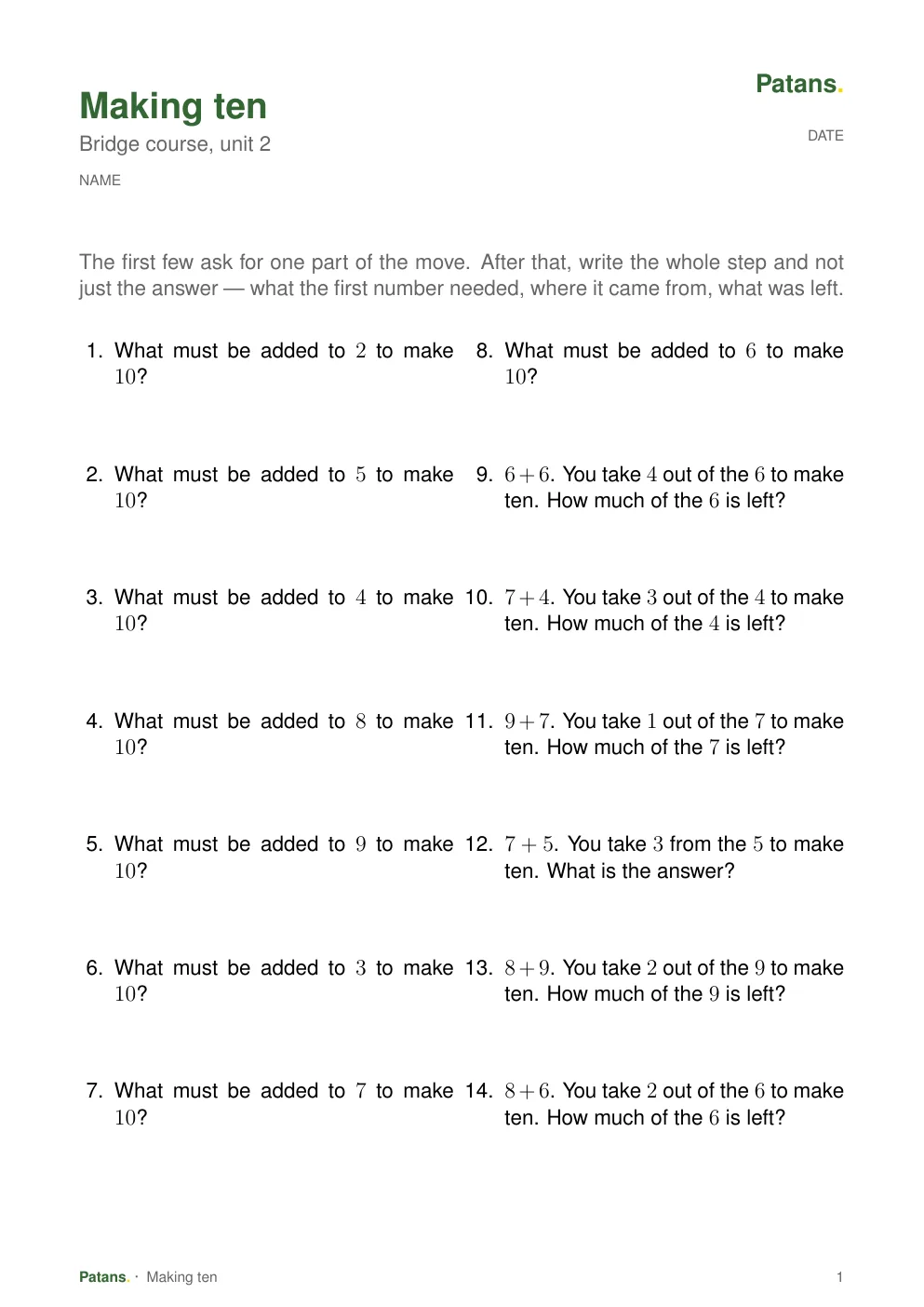
What must be added to $2$ to make $10$?
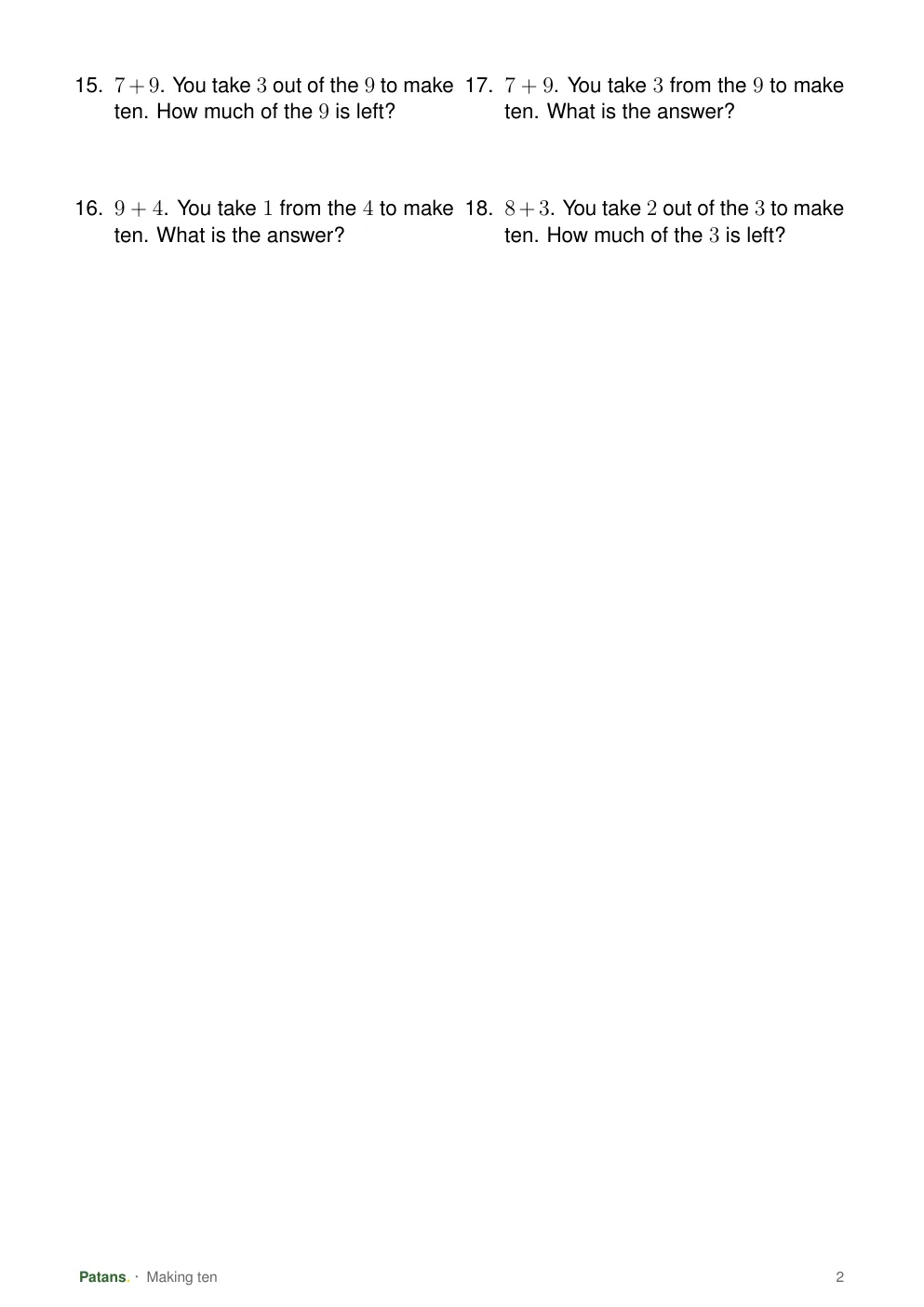
$7 + 9$. You take $3$ out of the $9$ to make ten. How much of the $9$ is left?
Which of these is $8 + 5$, done by making ten?
$7 + 6$
Away from the screen
Show that you have it
One fact, and the ones it hands you
You know $7 + 9 = 16$. What is $67 + 9$?
You know $9 + 8 = 17$. What is $29 + 8$?