Nobody is left behind
Before you read anything
Fourteen children are going on a trip. Each car holds four.
Work out how many cars. Say your answer before you read on — and then say what happens to the children it does not fit.
Three is not enough
The division says three and a bit. The answer is four, and the fourth car is not full.
Why nobody had to tell you
You did not need a rule for this. You needed to notice that the two left over are children, and that children get in a car.
This is the module 6 question — how many groups — and it is the one where the leftover makes another group, even a half-empty one.
The same numbers, going the other way
cut 14 metres of rope into 4-metre pieces and got 3
Nakato is right, and she did not round up. Two metres of rope is not a four-metre piece; it is two metres of rope, and no amount of wanting makes it another one.
Same $14$ and same $4$. Three, or four, depending only on what they are.
Check yourself
Six to try
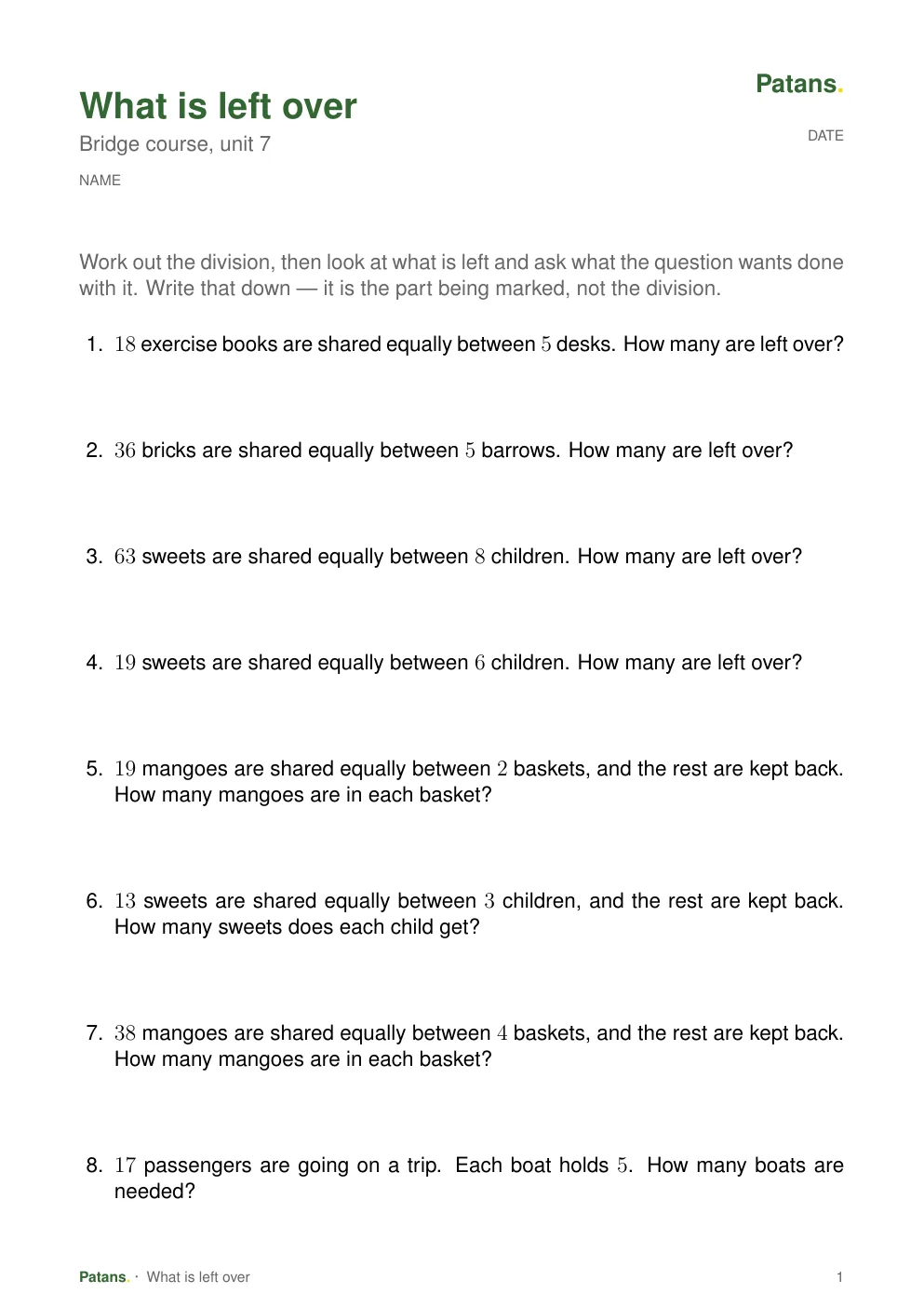
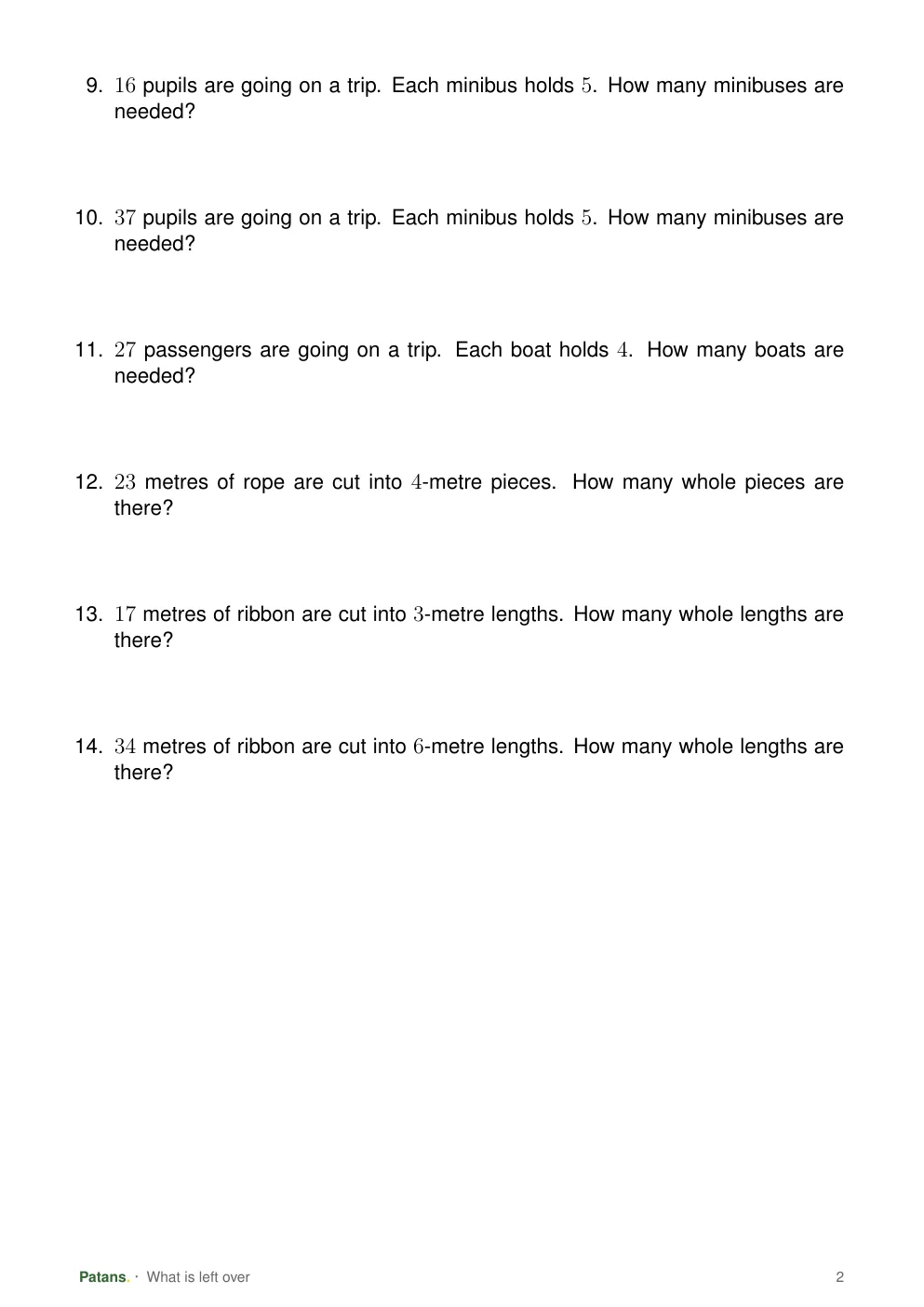
$16$ pupils are going on a trip. Each minibus holds $5$. How many minibuses are needed?
$23$ metres of rope are cut into $4$-metre pieces. How many whole pieces are there?
$17$ passengers are going on a trip. Each boat holds $5$. How many boats are needed?
$17$ metres of ribbon are cut into $3$-metre lengths. How many whole lengths are there?
$27$ passengers are going on a trip. Each boat holds $4$. How many boats are needed?
$34$ metres of ribbon are cut into $6$-metre lengths. How many whole lengths are there?
Away from the screen
Show that you have it
Which one needs an extra
In which of these is the answer one more than the division gives?
In which of these is the answer one more than the division gives?