Cut them both the same
Before you read anything
$\frac{2}{3}$ against $\frac{3}{5}$ — the pair module 9 left you with.
Thirds do not cut into fifths and fifths do not cut into thirds. Say what you could do to both of them instead.
Make the slices match
Cut every third into five, and cut every fifth into three. Both bars are now in fifteenths, and module 9 says that changed nothing about how much is shaded.
$\frac{2}{3}$ is $\frac{10}{15}$. $\frac{3}{5}$ is $\frac{9}{15}$.
Ten against nine. Once the slices match you are back in lesson 10.2's easy case, and you are simply counting.
Where the fifteen comes from
Three fives, or five threes. Any number both will cut into would do — $30$ works, $60$ works — but $15$ is the smallest and makes the smallest numbers to count.
compared $\frac{2}{3}$ and $\frac{3}{5}$ by comparing 2 with 3
Otim compared the counts while the slices were different sizes. Two big pieces can easily beat three small ones, which is exactly why the slices have to be made to match first.
The order to do things in
- Same slices? Count them.
- Same count? Compare the slices.
- Neither? Cut them both until the slices match, then count.
Only the third one is work.
Check yourself
Six to try
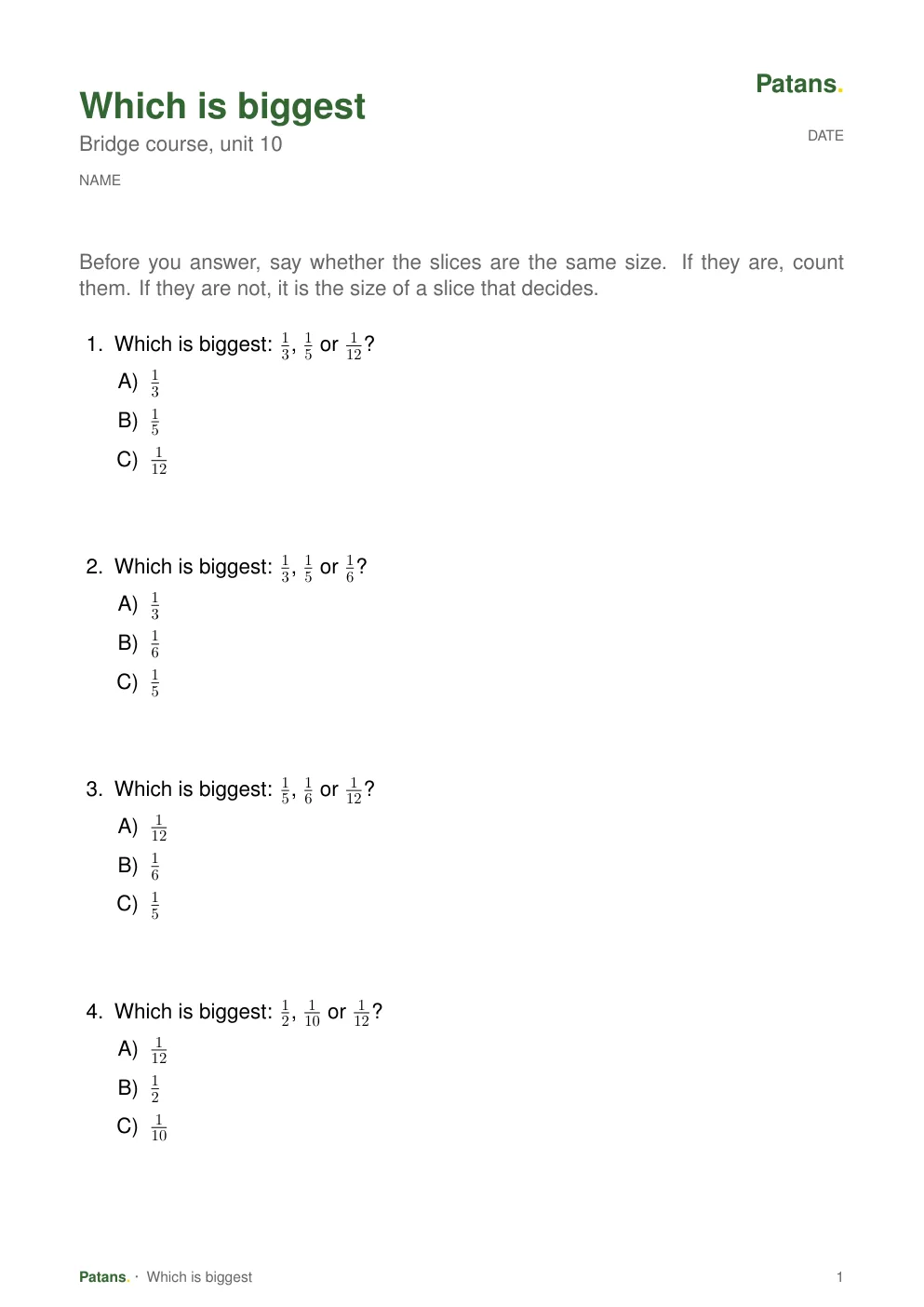
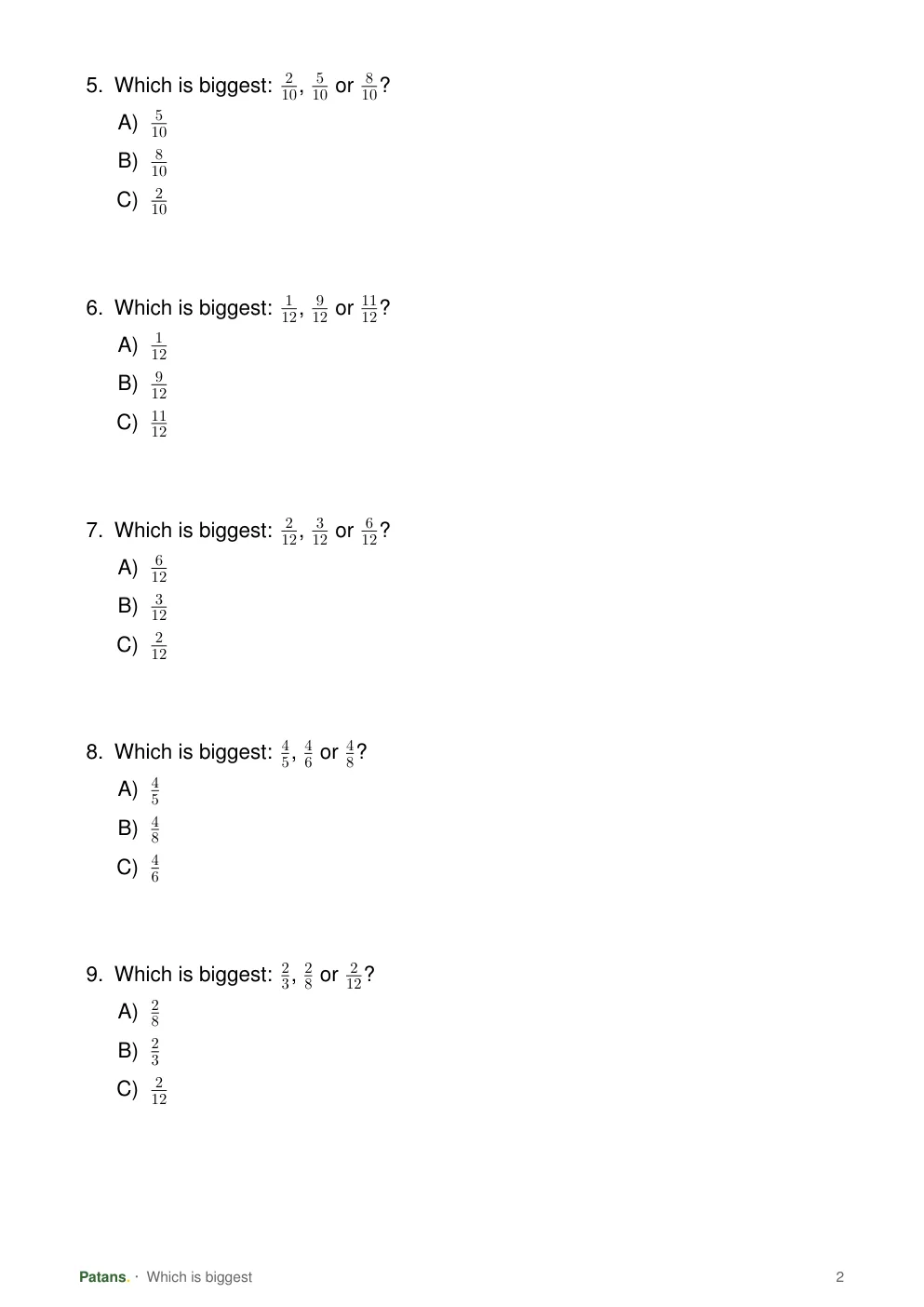
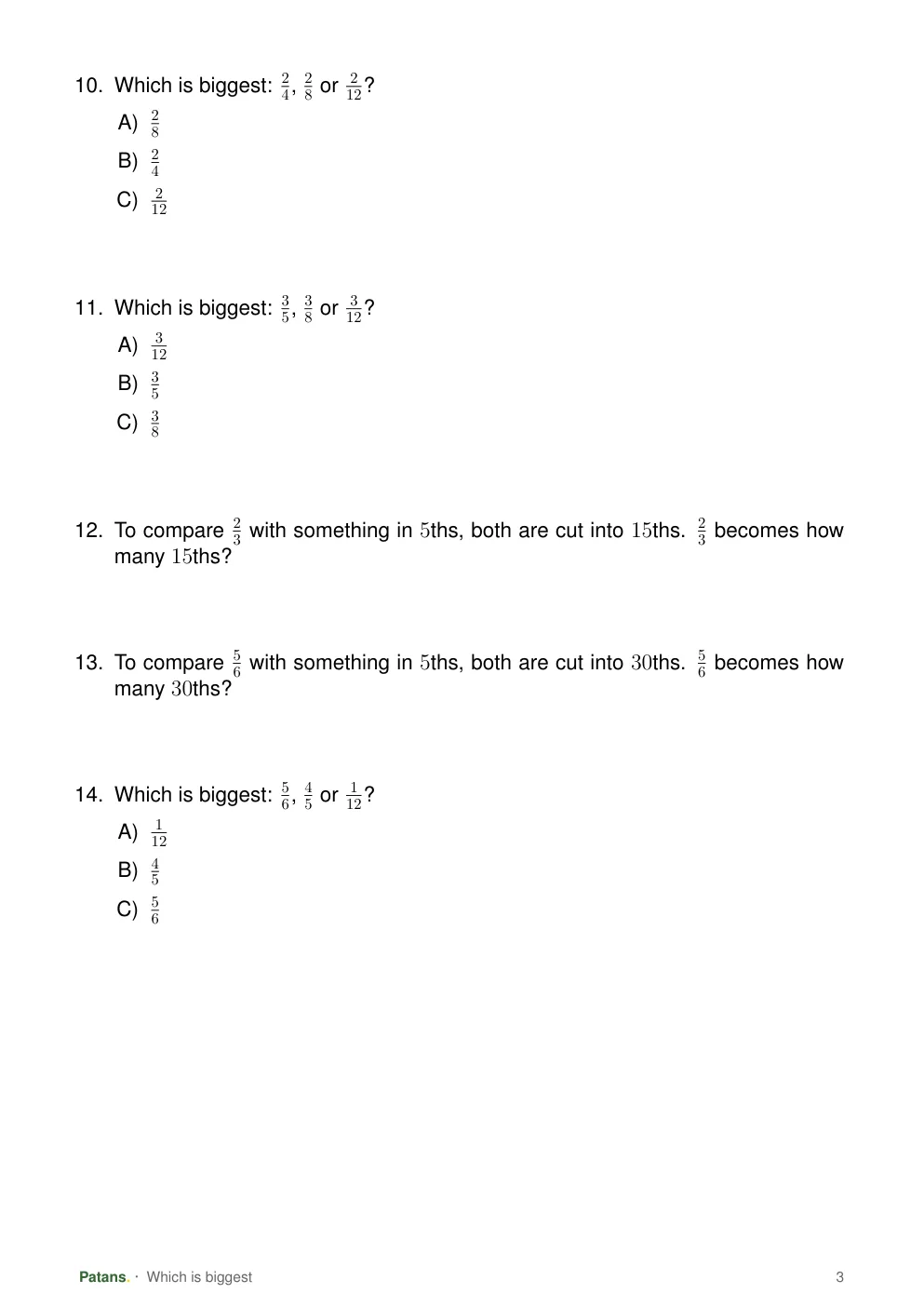
To compare $\frac{2}{3}$ with something in $5$ths, both are cut into $15$ths. $\frac{2}{3}$ becomes how many $15$ths?
Which is biggest: $\frac{5}{6}$, $\frac{4}{5}$ or $\frac{1}{12}$?
To compare $\frac{5}{6}$ with something in $5$ths, both are cut into $30$ths. $\frac{5}{6}$ becomes how many $30$ths?
Which is biggest: $\frac{1}{4}$, $\frac{2}{5}$ or $\frac{1}{10}$?
Which is biggest: $\frac{3}{5}$, $\frac{2}{4}$ or $\frac{1}{10}$?
Put these in order, smallest first.
Away from the screen
The question this leaves you with
$\frac{1}{2} + \frac{1}{3}$.
You now know how to make those slices match. So you can already do this — but first say why $\frac{2}{5}$ is wrong, because it is the answer almost everybody writes.
Show that you have it
Neither of the easy cases
Which is biggest: $\frac{3}{8}$, $\frac{2}{5}$ or $\frac{1}{16}$?
Put these in order, smallest first.