More pieces, smaller pieces
Before you read anything
Two identical strips of paper. Fold one into three and the other into twelve.
Tear one piece off each. Hold them side by side and say which is bigger — then look at the numbers you would write for them.
Two bars, the same length
The numbers point the wrong way
$\frac{1}{12}$ has the bigger number in it and is the smaller amount. That is not a trick and it is not an exception: the bottom number counts the pieces the bar was cut into, and twelve pieces have to fit where three did.
:x nutshell-bigger-bottom
More pieces in the same whole, so each piece is smaller. The bottom number is a size, and it runs backwards.
The most reliable wrong answer in primary maths
said $\frac{1}{8}$ beats $\frac{1}{5}$ because 8 beats 5
Musa read the bottom number as an amount. It is not one — it is an instruction about how finely to cut, and finer cutting makes smaller pieces every time.
A :bigger bottom number always means a smaller slice, as long as the wholes are the same size.
As long as the wholes are the same
Half of a biscuit is less than a quarter of a cake. Comparing fractions only means anything when they are fractions of the same whole — and for the rest of this unit they always are.
Check yourself
Six to try
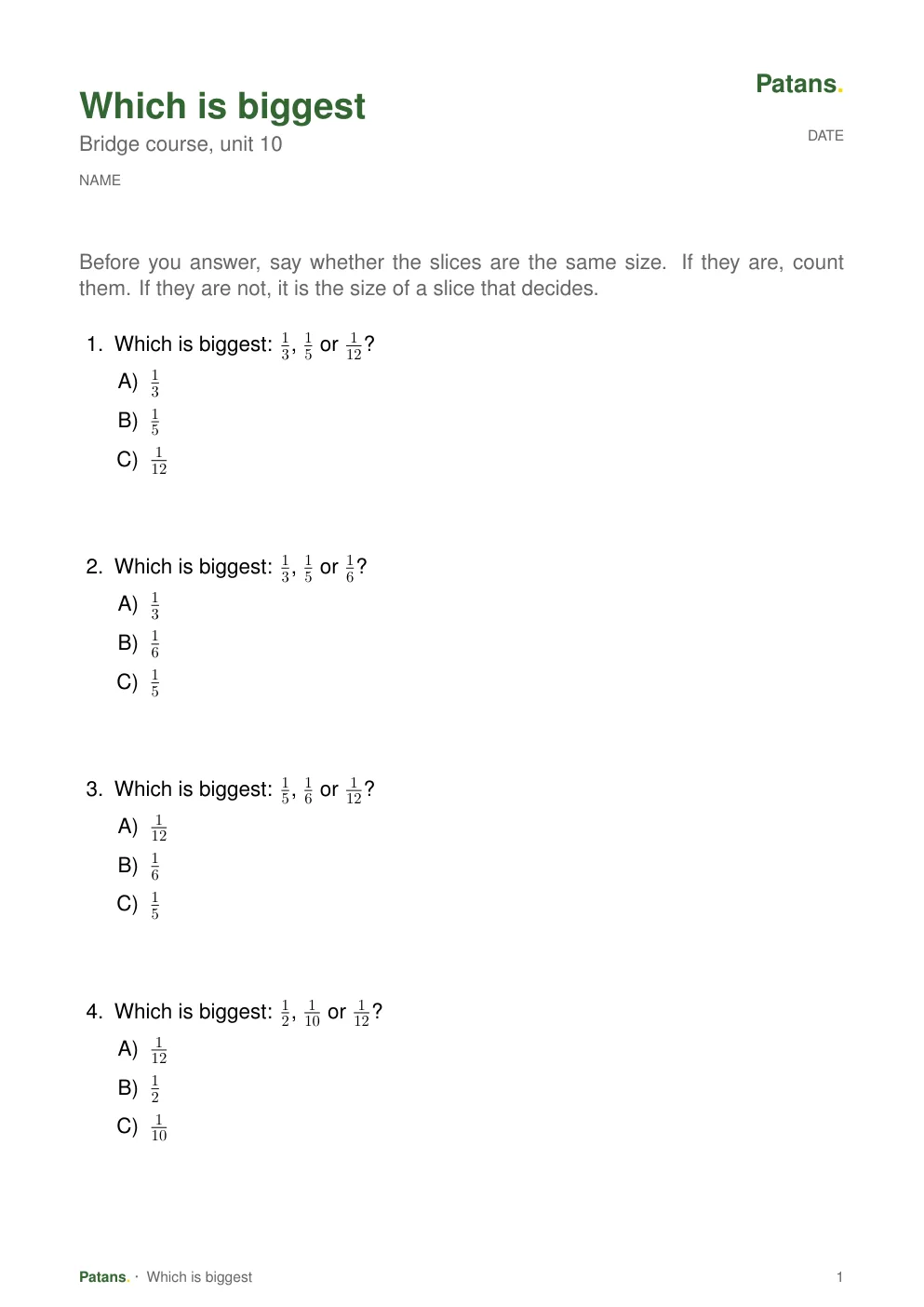
Which is biggest: $\frac{1}{3}$, $\frac{1}{5}$ or $\frac{1}{6}$?
Which is biggest: $\frac{1}{3}$, $\frac{1}{5}$ or $\frac{1}{12}$?
Which is biggest: $\frac{1}{2}$, $\frac{1}{10}$ or $\frac{1}{12}$?
Which is biggest: $\frac{1}{5}$, $\frac{1}{6}$ or $\frac{1}{12}$?
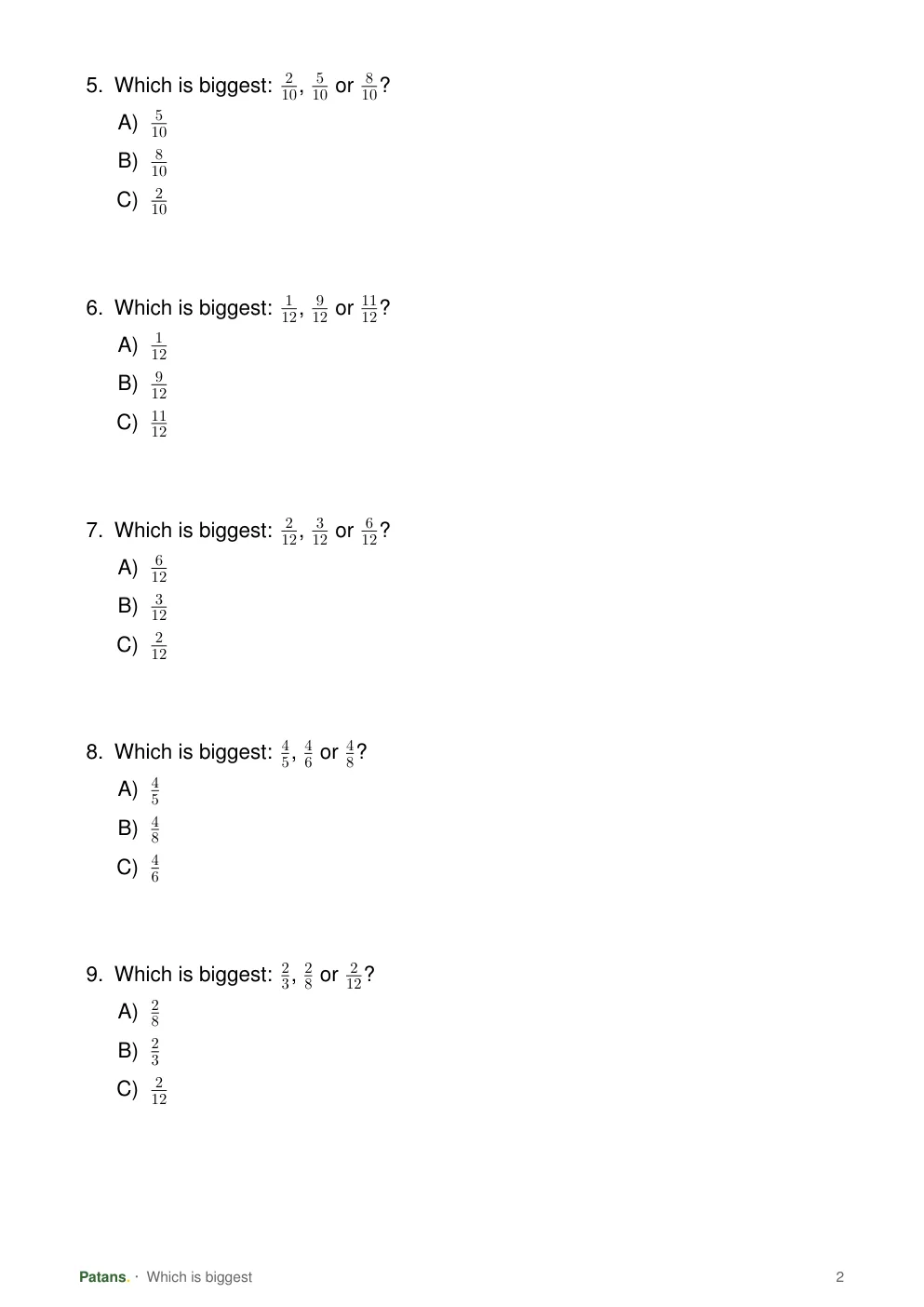
Which is biggest: $\frac{2}{10}$, $\frac{5}{10}$ or $\frac{8}{10}$?
Put these in order, smallest first.
Away from the screen
Show that you have it
The reason, and the order
Why is $\frac{1}{10}$ smaller than $\frac{1}{4}$?
Put these in order, smallest first.