Groups of the same size
Before you read anything
Four small piles, six stones in each. Make them. Do not count the lot yet.
Say out loud how many piles there are, and how many are in one pile. Two numbers, and they are not the same kind of thing.
The question module 3 left you with
Module 3 kept saying forty is four tens. That is a count of equal groups, said out loud, before anybody called it one.
Every count of equal groups is a multiplication. Four tens, four sixes, four of anything — as long as the piles match.
What you just did
The two numbers do different jobs
:x nutshell-equal-groups
Piles that all hold the same amount. If one pile is short, counting them as a multiplication gives the wrong answer.
In $4 \times 6$ the first number says how many piles and the second says how many in each. :Equal groups is the whole condition — nothing else is needed, and nothing less will do.
Not four and six
read $4 \times 6$ and wrote 10
counted her piles and wrote 24
Musa added the labels instead of the stones. Four and six describe the piles. Neither of them is an amount of anything.
The bar you already have
Module 1 cut a bar into two parts. This is that bar with four parts and every one the same length — which is exactly why one number is enough to say how big they are.
Check yourself
Six to try
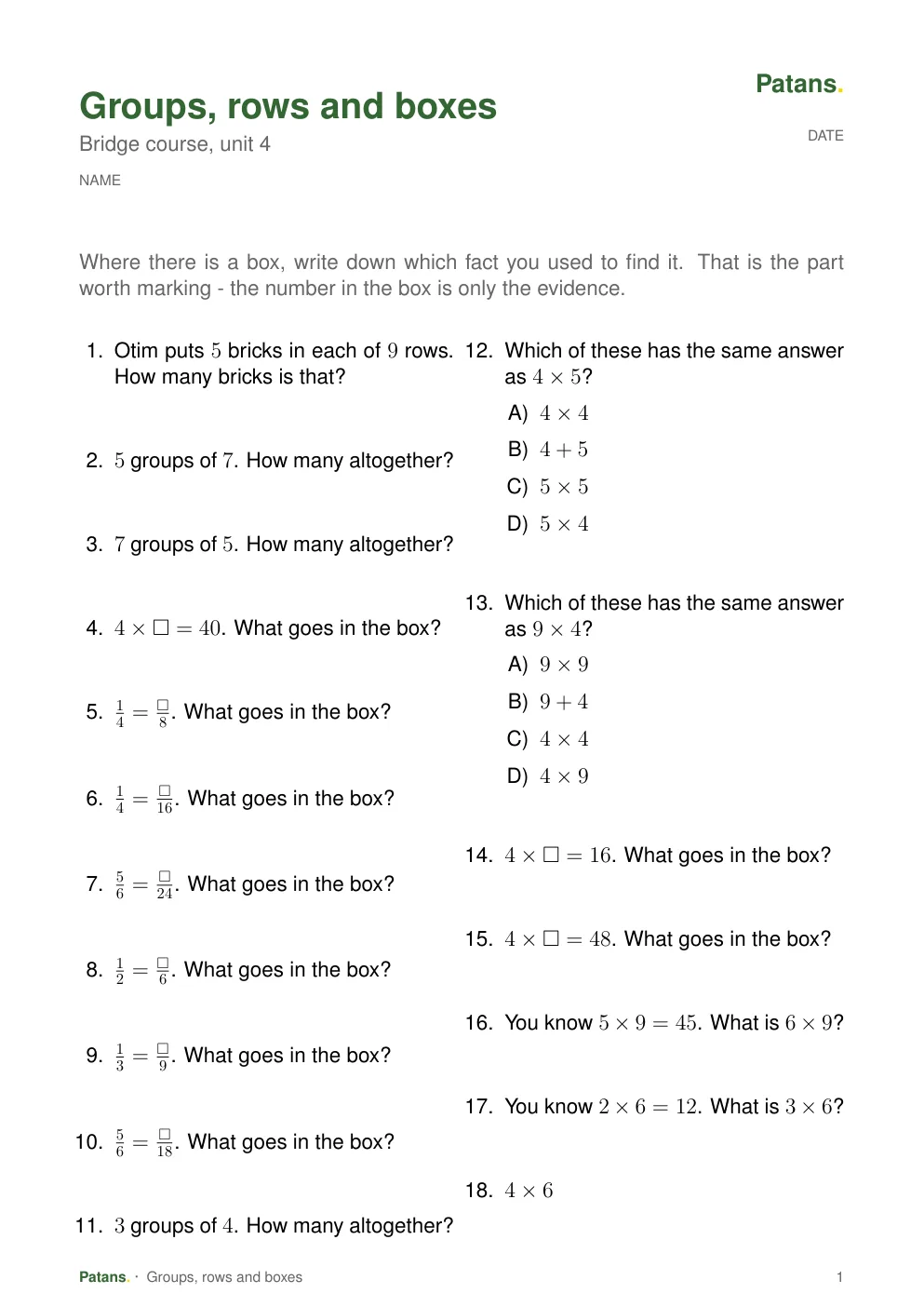
$3$ groups of $4$. How many altogether?
$9$ groups of $7$. How many altogether?
Otim puts $5$ bricks in each of $9$ rows. How many bricks is that?
$4 \times 6$
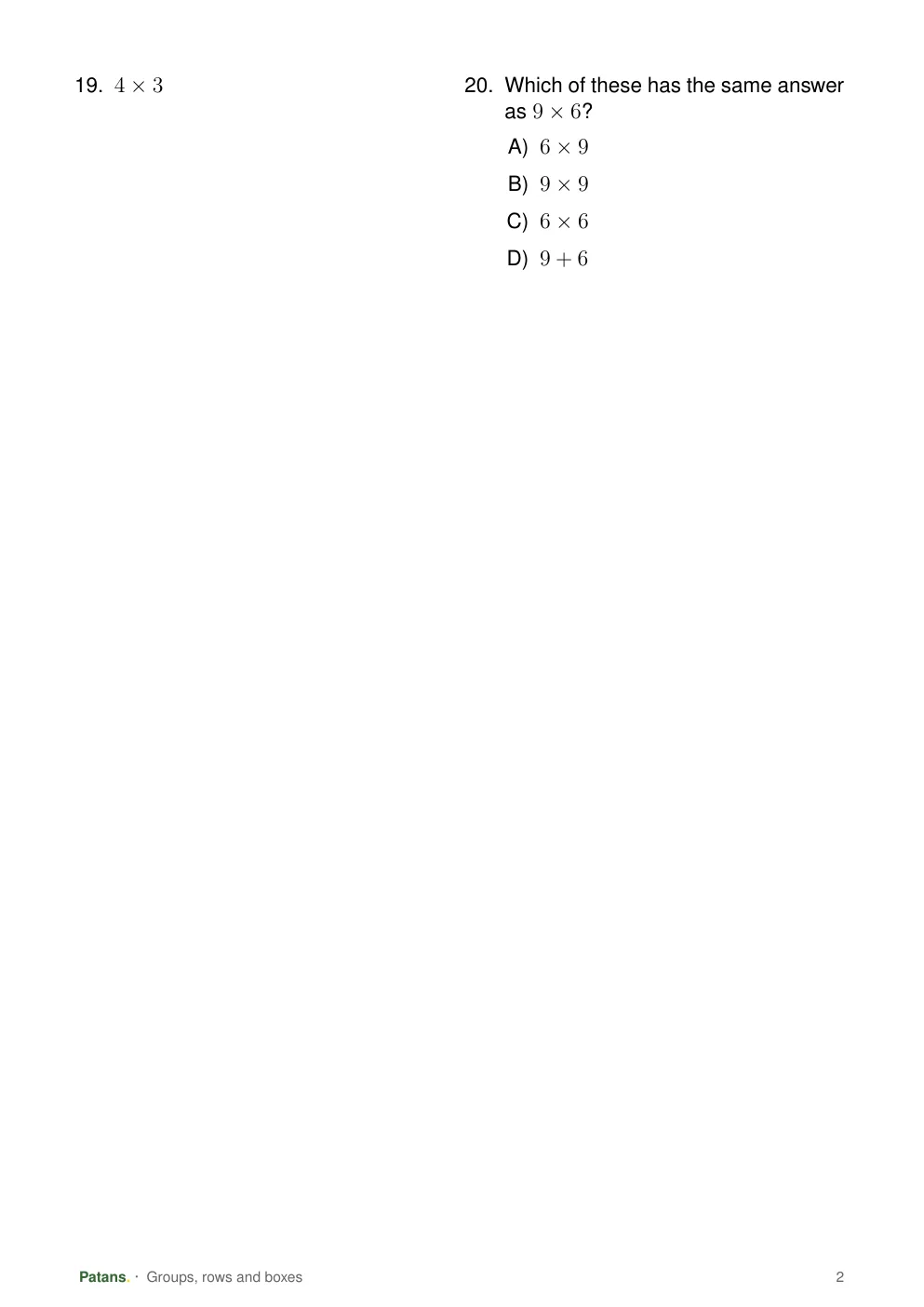
$4 \times 3$
$5$ groups of $7$. How many altogether?
Away from the screen
Show that you have it
The box, with one side missing
$4 \times \square = 16$. What goes in the box?
$4 \times \square = 48$. What goes in the box?