Turn it a quarter turn
Before you read anything
Lay your twenty-four stones out as four straight rows of six. No heaps.
Now walk round the table and look at the same stones from the side. Say what you see from there.
The same stones, from the side
Nobody added a stone and nobody took one away. So $4 \times 6$ and $6 \times 4$ are not two facts. They are one fact and two places to stand.
Why straight rows
:x nutshell-array
Things in straight rows, all the same length. A heap has to be counted. An array can be read.
Four heaps of six and six heaps of four cannot be told apart by looking. Made into an :array, they are one rectangle seen twice, and nobody has to count anything to see it.
The half that disappears
Every fact in the times table has a twin on the other side of the diagonal. $7 \times 8$ and $8 \times 7$ are the same tray. Learn one and you have both, which takes the work you are facing and halves it before you start.
Halved, and still a lot
Seventy-two is still seventy-two. And you cannot stop in the middle of a longer question to work out $7 \times 8$ without losing the question.
Where this does not work
tried the same turn on $9 - 4$
Turning a tray is a fact about rectangles, not a rule about order. There is no rectangle behind $9 - 4$, so nothing turns and $4 - 9$ is a different question.
Check yourself
Six to try
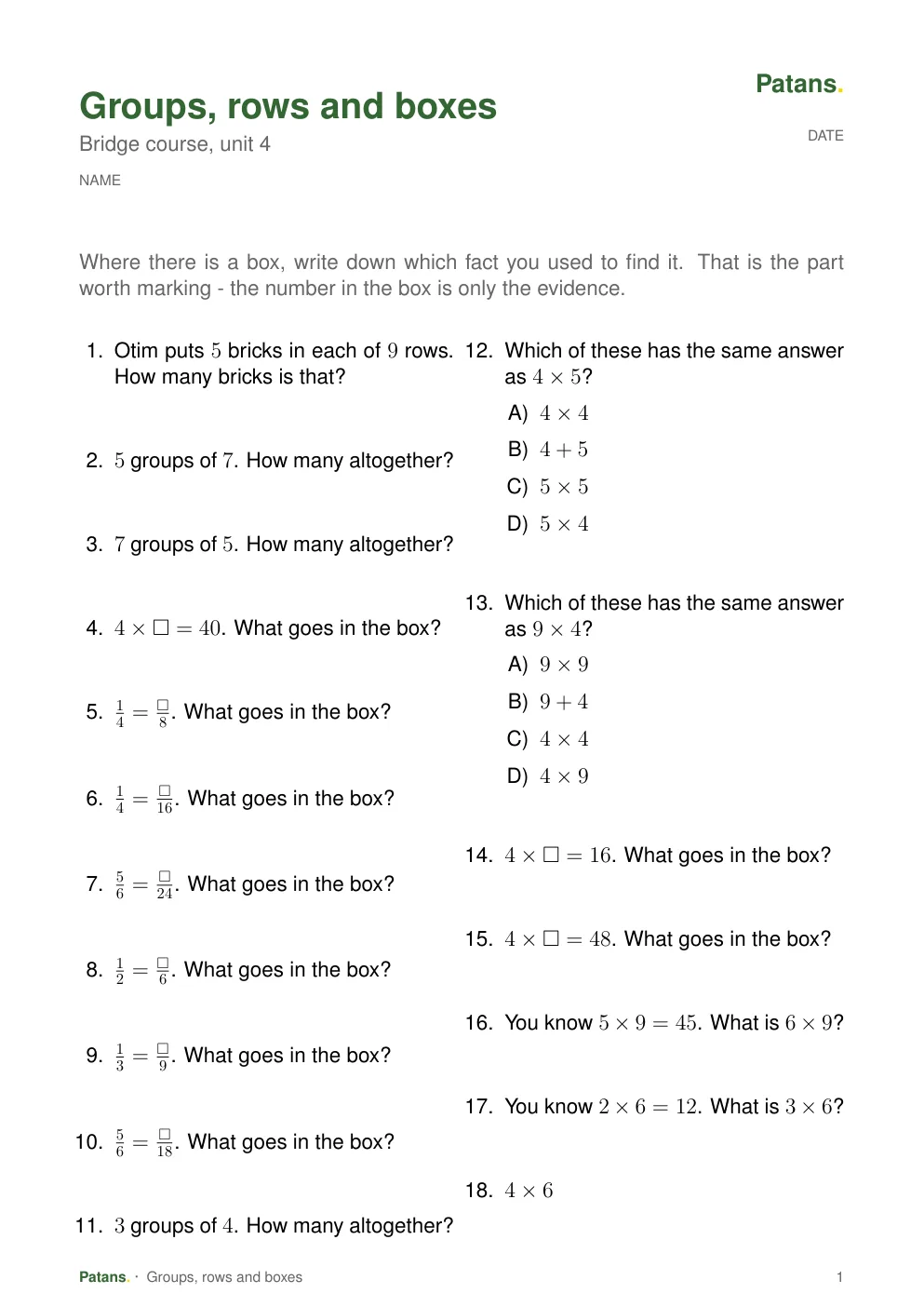
Which of these has the same answer as $4 \times 5$?
Which of these has the same answer as $9 \times 4$?
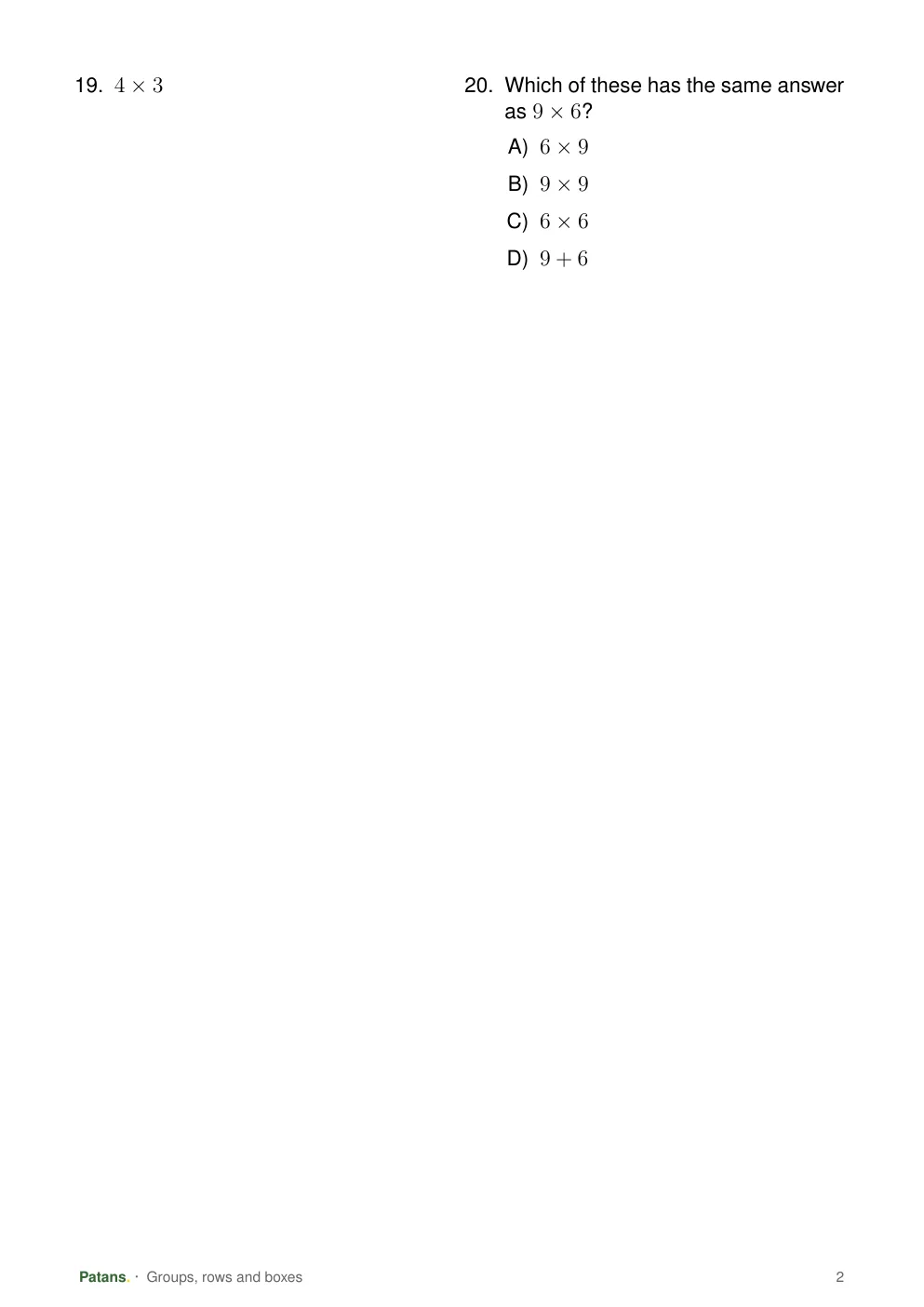
Which of these has the same answer as $9 \times 6$?
Which of these has the same answer as $6 \times 5$?
Which of these has the same answer as $8 \times 7$?
$4 \times 6$
Away from the screen
Show that you have it
One fact, asked from the other side
$5$ groups of $7$. How many altogether?
$7$ groups of $5$. How many altogether?