Deduce whether fractions will have recurring or terminating decimal equivalents.
Estimate and divide decimals by numbers with one decimal place.
Estimate and multiply decimals by integers and decimals.
Estimate, add and subtract integers, recognising generalisations.
Estimate, multiply and divide integers including where one integer is negative.
Estimate, multiply and divide integers, recognising generalisations.
Multiply and divide integers and decimals by 10 to the power of any positive or negative number.
Recognise positive and negative cube numbers, and the corresponding cube roots.
Recognise squares of negative and positive numbers, and corresponding square roots.
Round numbers to a given number of decimal places.
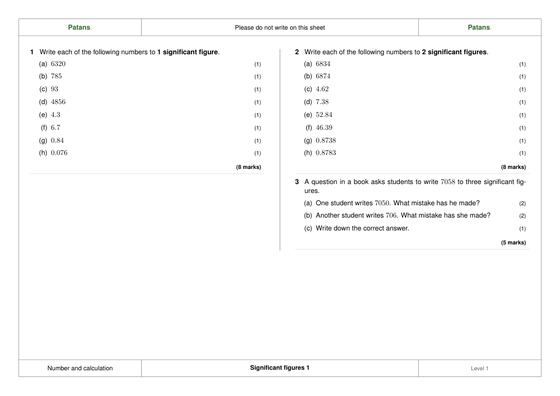
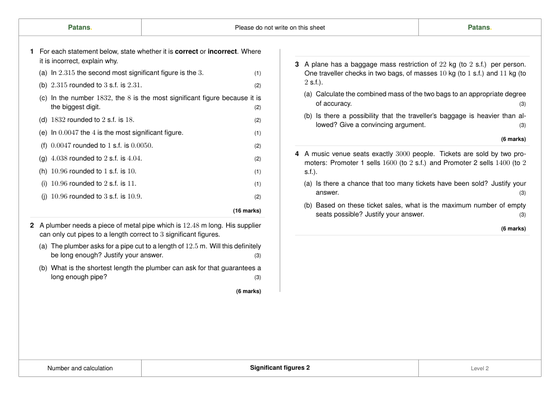
Round numbers to a given number of significant figures.
Understand factors, multiples, prime factors, highest common factors and lowest common multiples.
Understand how to manipulate algebraic expressions including:expanding the product of two algebraic expressionsapplying the laws of indicessimplifying algebraic fractions.
Understand lowest common multiple and highest common factor (numbers less than 100).
Understand that brackets, indices (square and cube roots) and operations follow a particular order.
Understand that brackets, positive indices and operations follow a particular order.
Understand the difference between rational and irrational numbers.
Understand the relationship between squares and corresponding square roots, and cubes and corresponding cube roots.
Understand the standard form for representing large and small numbers.
Use knowledge of place value to multiply and divide integers and decimals by 0.1 and 0.01.
Use knowledge of place value to multiply and divide whole numbers and decimals by any positive power of 10.
Use knowledge of square and cube roots to estimate surds.
Use knowledge of tests of divisibility to find factors of numbers greater than 100.
Use knowledge of the laws of arithmetic and order of operations (including brackets) to simplify calculations containing decimals or fractions.
Use positive and zero indices, and the index laws for multiplication and division.
Use positive, negative and zero indices, and the index laws for multiplication and division.